
Last Updated: October 18, 2026
You can reduce vehicle carbon emissions by a real chunk with basic tools and a free afternoon.
Gather a few basics:
A level driveway and daylight will do, no lift needed.
Reduce vehicle carbon emissions by starting with the cheap, safe stuff first: tires, filters, and driving habits come before anything under the hood.
Regular DIY car maintenance to reduce emissions is the highest-value work most owners skip. A clean air filter, fresh oil, and correct tire pressure keep the engine burning fuel efficiently, cutting fuel consumption and exhaust emissions.
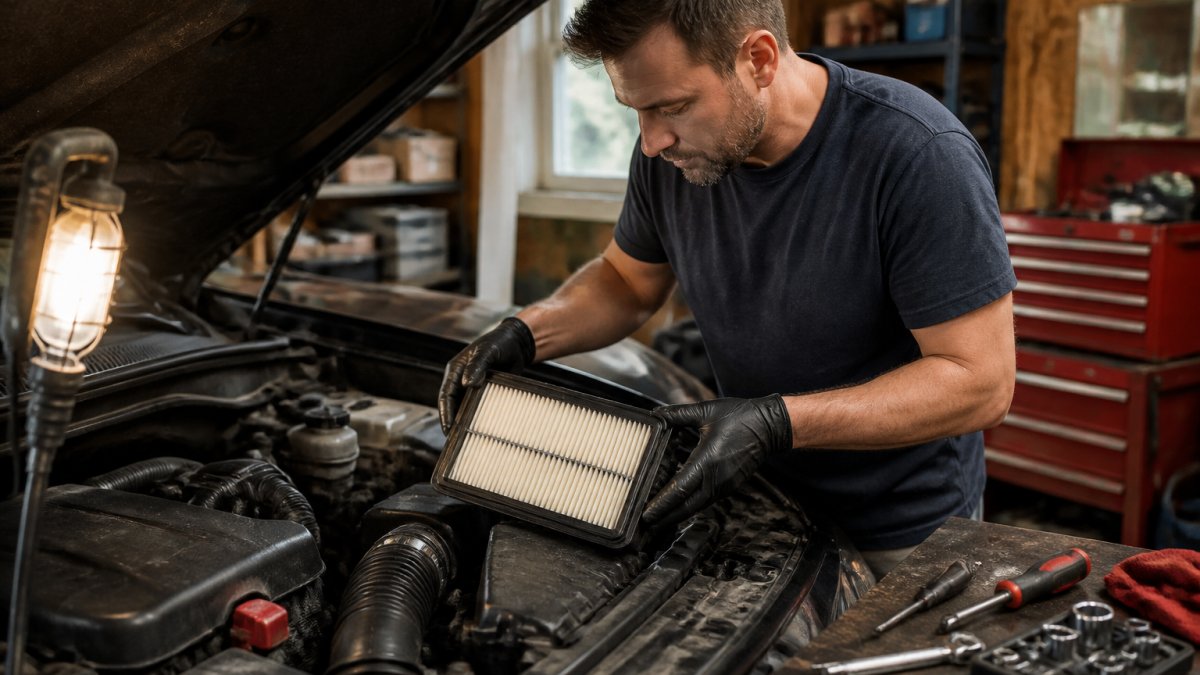
Start with these three jobs. None takes more than 30 minutes.
Old oil gets thick and dirty, so the engine works harder and burns more fuel; fresh oil of the right grade keeps friction low. A clogged air filter chokes the engine, making it run rich and raising carbon dioxide output.
Some jobs are safe for a home mechanic; others can damage your engine or void your warranty.
Do it yourself:
Leave it to a shop:
Forcing a repair you don't fully understand is a common mistake. A stripped bolt or crossed sensor wire can cost far more than the shop bill you avoided.
Fuel-efficient driving tips are free and work on day one. Smooth acceleration, steady speed, and less idling all cut fuel consumption and carbon emissions without touching a wrench.
The U.S. Department of Energy's fuel economy guidance points out that aggressive driving, rapid acceleration, and speeding all burn extra fuel for no benefit.
Idling gets you zero miles per gallon, burning fuel and pumping out exhaust emissions while you sit still, if you're parked for more than a minute, shut the engine off. Fuel economy drops fast above highway speeds because wind resistance climbs, so ease off the gas and hold a steady speed. Smooth acceleration means pressing the pedal like there's an egg under it: same speed, less wasted fuel.
Tire pressure and fuel economy are directly linked, and this is the easiest win in the guide. Underinflated tires flex more as they roll, converting engine power into heat instead of forward motion, so the engine burns more fuel and raises carbon dioxide output per mile.
Check pressure once a month with a gauge, using the door-jamb sticker (the manufacturer's cold-pressure spec), not the sidewall. Check when tires are cold, before driving far or after the car has sat at least three hours.
A tire 10 psi below its recommended pressure can raise rolling resistance enough to cost a measurable slice of fuel economy.
Better tire pressure cuts carbon dioxide because it cuts fuel burned, but it does not meaningfully change nitrogen oxides or particulate matter, which are governed by combustion temperature and engine tuning. Tire pressure is a carbon win, not an air-quality fix.
Low pressure also wears tires faster and hurts handling. A five-minute check protects your wallet and your safety.
Do not inflate to the maximum pressure printed on the tire sidewall. That number is the tire's load limit, not your vehicle's recommendation. Overinflation reduces traction and causes uneven wear.
Vehicle emissions test preparation starts weeks before the test, not the morning of. A well-maintained car with no warning lights almost always passes, but you need to understand what the test measures, and it is not measuring carbon dioxide.
read more here to understand this technology →
State inspection programs focus on local air pollutants: hydrocarbons, carbon monoxide, nitrogen oxides, and sometimes particulate matter. Carbon dioxide, the main greenhouse gas from a vehicle, is not what the test fails you for. Burning less fuel does not automatically fix a nitrogen oxide problem caused by a faulty catalytic converter or a lean-running engine.
A failed test signals a combustion or emissions-control fault, not a carbon footprint problem. Fix the fault and both outcomes improve.
If your car failed last time, don't just retest and hope. A misfire, bad oxygen sensor, or failing catalytic converter all show up in the codes, and your local auto parts store can read them for free.
The EPA's vehicle emissions and inspection overview explains how state inspection programs check exhaust emissions and engine performance.
Reducing vehicle carbon emissions with an HHO kit is a real option for drivers who want more than habits alone can deliver.
HHOKitsDirect builds DIY HHO generator kits for cars, trucks, RVs, and boats.
What to expect in practice:
Our H2XTRME generators carry a Limited Lifetime warranty.
One honest note: results vary by vehicle, engine condition, and driving style. An older, high-mileage engine may respond differently than a newer one.
Measuring your emissions and fuel savings before and after any change is how you know what actually worked. Track these numbers for two to three weeks before changing anything:
After a change, repeat the same routine, same routes, driving style, and fill-up method, then compare.
The U.S. Energy Information Administration's data on gasoline and the environment helps you put your fuel use in context.
A simple tracking sheet keeps you honest:
| What to Track | Before | After | What It Tells You |
|---|---|---|---|
| Average MPG | Week 1-3 | Week 5-7 | Fuel savings |
| Weekly fuel cost | Baseline | New | Money saved |
| Check engine light | Status | Status | Engine health |
| Idle time per trip | Estimate | Estimate | Habit change |
Not every action is worth your time on day one. Here's how we'd rank the work, from cheapest and easiest to biggest investment.
| Action | Cost | Effort | Likely Impact |
|---|---|---|---|
| Check tire pressure | Free | 5 minutes | High |
| Cut idling and speeding | Free | Habit change | High |
| Combine errands and plan routes | Free | Low | Medium |
| Change air filter | Low | 15 minutes | Medium |
| Change oil and filter | Low | 30 minutes | Medium |
| Prepare for emissions test | Low | An afternoon | High if you're due |
| Add an HHO kit | Varies | A weekend | Adds to the gains above |
Knock out the free wins first, then work down. By the time you reach the bigger steps, you'll have a clean baseline and real numbers to compare against.
Cutting vehicle carbon emissions isn't one big fix. When you're ready to go further, HHOKitsDirect's DIY HHO generator kits add a combustion catalyst that helps your engine run cleaner, with a sealed container design, simple two-terminal installation, and a Limited Lifetime warranty on H2XTRME generators.
Yes. A clean air filter, fresh engine oil, and properly gapped spark plugs help the engine burn fuel more completely, which lowers exhaust emissions. Checking tire pressure weekly is the cheapest maintenance step, since underinflated tires increase rolling resistance and fuel consumption. Keep a simple log of service dates and mileage so you can spot a missed interval. If the check engine light comes on, scan the code before the next emissions test rather than waiting.
It does. Most cars hit peak fuel economy between 50 and 60 mph, and every 5 mph above 50 mph adds roughly 7 percent to fuel costs according to the U.S. Department of Energy. Steady speeds, smooth acceleration, and less idling all cut fuel consumption and the carbon dioxide that comes with it. On highways, use cruise control where it is safe to hold a constant speed instead of speeding up and slowing down.
HHO kits act as a combustion catalyst, feeding small amounts of hydrogen and oxygen into the intake to help fuel burn more completely. Real-world results vary by vehicle, engine condition, and driving style, so treat any mileage or emissions claim as a starting point to verify on your own car. Measure baseline fuel economy over at least three tanks before installing a kit, then compare after. HHOKitsDirect publishes a mileage results chart and a limited lifetime warranty on its H2XTRME generators.
Watch for a check engine light, a rotten-egg smell from the exhaust, visible smoke, rough idle, or a sudden drop in fuel economy. Any of these can point to a rich fuel mixture, a failing catalytic converter, or a bad oxygen sensor. A scan tool that reads OBD-II codes costs under $50 and shows pending codes before the light comes on. Fix small issues early; a failed emissions test usually costs more than the repair that would have prevented it.

Subscribe to our newsletter and always be the first to hear about what is happening.
© 2026 HHOKitsDirect.com
Designed by Out of the Sandbox. Powered by Shopify


Note and Disclaimer: Hydrogen or Hydroxy gas and hydrogen cells are experimental technologies, results vary depending on application success is not guaranteed.
Editorial Team
Author