
Last Updated: October 13, 2026
A hydrogen generator for cars uses water electrolysis to produce hydrogen and oxygen on demand while your engine runs. These gases enter the air intake as a combustion catalyst, helping fuel burn more completely.
Water enters the generator, where alternator current separates it into hydrogen (H2) and oxygen (O2). Nothing is stored, the gases are produced and used immediately, eliminating pressurized-tank safety concerns. They pass through a filter that removes water vapor and contaminants, then flow into your engine's air intake.
Unlike fuel additives or engine modifications, you're not replacing gasoline or diesel, you're supplementing combustion with a cleaner, more reactive gas mixture for better mileage, lower emissions, and often improved throttle response.
Modern implementations like H2XTRME advance the decades-old technology: welded plastic containers eliminate leak-prone gaskets and bolts, internal plate designs maximize gas production while minimizing water consumption, and tuner electronics adapt to carburetor, fuel injection, or diesel.
HHO systems produce measurable combustion improvements in controlled conditions, but fuel savings depend on several factors.
Electrolysis consumes alternator power, typically 15-40 amps depending on generator size and driving conditions. The question is whether combustion efficiency gains exceed that load.
Older engines with carbon buildup show the most dramatic improvements: a 20-year-old truck with 200k miles often responds better than a newer, cleaner engine, because hydrogen burns away deposits that restrict combustion efficiency. Once cleaned, savings stabilize at more modest levels.
The honest limitation: no independent laboratory has published peer-reviewed studies proving a specific fuel economy gain across diverse vehicle types, only user reporting and anecdotal evidence.
Choosing the right HHO kit starts with engine displacement. The H2XTRME lineup comes in three sizes for four-, six-, eight-cylinder, and heavy-duty engines, each including the generator, reservoir, filter, hoses, wiring, mounting brackets, and an illustrated installation manual.
The Small H2XTRME kit at $597.00 suits compact cars, sedans, and smaller trucks with four- to six-cylinder engines under 3.7 liters. Its 13-plate generator measures just 3.5 inches thick and 8 inches wide, fitting tight engine bays.
Its chemically welded plastic container eliminates gaskets and bolts, meaning fewer leak points, with just two electrical and two hose connections. Installation takes most DIY enthusiasts 2-4 hours without special tools. Options cover carbureted vehicles, fuel-injected cars (1987 and newer), diesels, or advanced tuning with a Pro Series tuner.
The included filter captures water vapor and filters to 1 micron, protecting your engine from salt and alkaline damage. A Limited Lifetime warranty covers the generator.
At $747.00, the Medium kit targets most truck owners and larger sedans. Its 19-plate generator handles six- and eight-cylinder engines up to 6.7 liters, pickup trucks, SUVs, and performance cars.
It's thicker than the Small (4.5 inches) to accommodate more plates, producing more hydrogen and oxygen for larger displacement engines, with the same sealed design and two-connection installation. Owners of older full-size trucks report the most consistent fuel economy improvements with this size, often because hydrogen cleans accumulated carbon deposits.
It also suits anyone upgrading an older system or wanting more gas production than a small kit provides. Tuner options are the same: carb, fuel injection, diesel, or Pro Series.
The Large H2XTRME at $897.00 is purpose-built for eight- to ten-cylinder engines, heavy-duty trucks, and RVs. Its 25-plate generator produces maximum hydrogen output for the largest displacement engines and highest electrical loads.
At 6 inches thick it's still compact versus older HHO systems, but it's the right pick for a diesel truck with a 7+ liter engine or towing with a big V10. Engineering is identical: welded container, sealed bolts, internal plate retainers, same installation simplicity.
One consideration: the Large kit draws more alternator current than smaller versions. If your alternator is marginal or you run heavy electrical accessories, verify capacity before ordering. Most modern trucks handle it fine; older vehicles sometimes need a modest alternator upgrade.
If you want to understand the technology deeply or source your own components, our $39.95 manual walks through the entire process, with bonus books on high-mileage carburetors, the history of hydrogen vehicles, and four build projects.
This isn't a shortcut, it requires mechanical aptitude, time, and materials: PVC or acrylic plates, stainless steel bolts, a container, hoses, and electrical components. For builders who enjoy the process and want to minimize cost, the manual shows exactly how to assemble and install a functional system.
The tradeoff: a homemade build lacks the engineering refinement of H2XTRME kits. But the fundamental principle, water electrolysis producing hydrogen, is the same.
| Kit | Engine Size | Price | Plates | Best For |
|---|---|---|---|---|
| Small H2XTRME | 1.1-3.7L | $597.00 | 13 | Four- and six-cylinder cars |
| Medium H2XTRME | 3.8-6.7L | $747.00 | 19 | Six- and eight-cylinder trucks |
| Large H2XTRME | 6.8-12L | $897.00 | 25 | Heavy-duty trucks and RVs |
| DIY Manual | Any | $39.95 | , | Builders and learners |
Installing an HHO kit is within reach of most DIY mechanics, because these systems minimize connections and complexity.

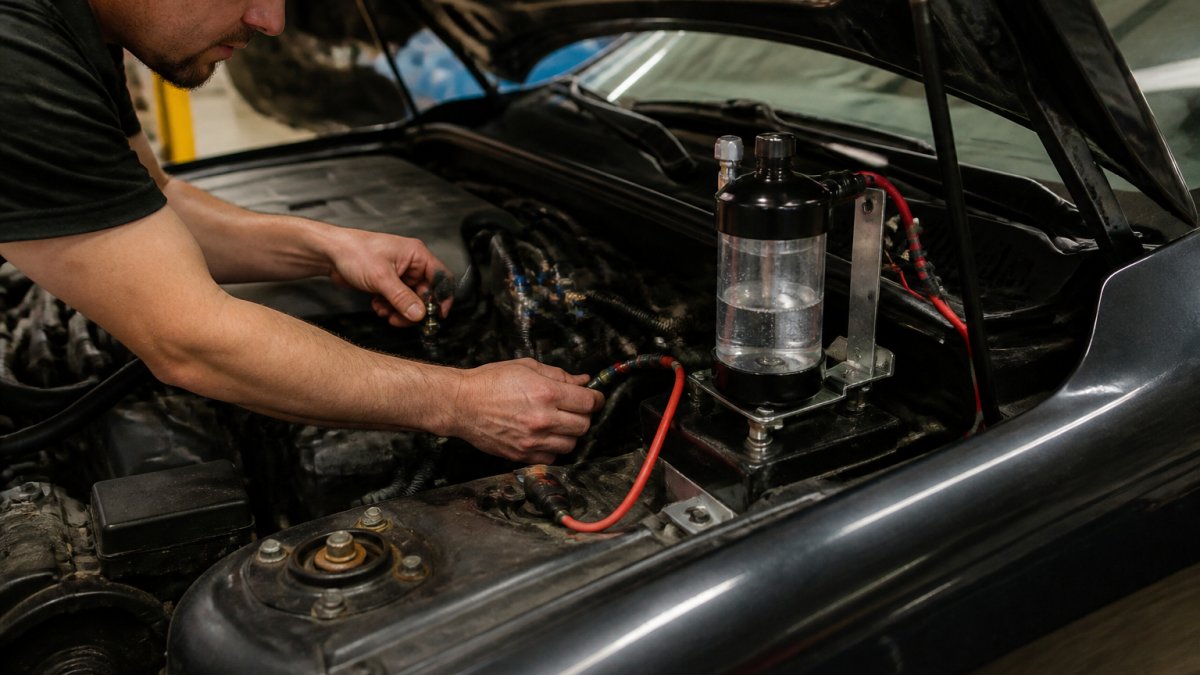
Step 1: Locate the Air Intake and Plan Placement
Step 2: Install the Generator and Reservoir
Mount the generator with the included custom brackets and secure the reservoir, our Ultra Slim Reservoir at $49.95 fits tight spaces.
Step 3: Connect the Hoses
Three hose lines run from the generator: water input, reservoir, and HHO gas to the air intake.
Step 4: Run the Electrical Connections
The two-connection design matters here: one wire to the positive battery terminal (through a relay for safety), one to ground.
Step 5: Fill with Water and Electrolyte
Add distilled water to the reservoir, then our Hydro Activator electrolyte ($23.95 for 16 ounces) to let electricity flow.
Step 6: Test and Tune
Start the engine. You should see hydrogen and oxygen flowing up the hoses from the generator into the reservoir, through the dryer filter, and into the air intake.

Water Level Monitoring
Check your reservoir weekly for the first month, then monthly. Our reservoirs have high and low fill lines molded into the plastic.
How To Build Your Own HHO gas generator kit and Install It →
Water consumption depends on driving conditions: city driving with frequent acceleration burns more, highway cruising less.
Electrolyte Concentration
The Hydro Activator (sodium hydroxide) dissolves in water and allows electricity to flow.
In freezing climates, increase electrolyte concentration slightly. Higher concentration lowers the freezing point, protecting your system in winter.
Filter Care
The dryer filter captures water vapor and particulates, protecting your engine, filtering to 1 micron internally, finer than most air filters.
Replace the filter element every 6-12 months depending on driving.
Some builders prefer sourcing components themselves. If you choose this path, understand both what's possible and what can go wrong.
Core Materials You'll Need
The plates are the heart of the system: conductive, corrosion-resistant, and properly spaced.
Container Options
Some builders use PVC pipe, others acrylic or polycarbonate.
Electrical Load Reality
A typical HHO generator draws 15-40 amps at 12 volts depending on plate count and electrolyte concentration.
Safety Limits You Must Respect
Hydrogen is flammable. It mixes with air and oxygen to form an explosive gas mixture if ignited.
Never run the system without water. The generator depends on water for cooling and function.
Never exceed your alternator's electrical capacity. Too much current through an undersized alternator causes overheating and failure.
Always use a relay to control the system.
Installing an HHO system raises legitimate questions about engine safety, emissions compliance, and warranty coverage.
Engine Safety and Compatibility
HHO systems don't damage engines when installed correctly.
Older carbureted engines (1980s and earlier) are often the most responsive.
Emissions and Inspection
HHO systems typically reduce emissions, cleaner combustion means less unburned fuel, less carbon monoxide, and often lower nitrogen oxides. However, emissions testing varies by jurisdiction and inspection method.
Some states use dynamometer testing (engine under load on a dyno), others OBD-II scanner readings.
If you're considering HHO for emissions purposes, test it first. Some vehicles respond well; others don't.
Warranty and Liability
Most manufacturers don't void your warranty simply because you installed an aftermarket part.
What we can't guarantee: that your specific vehicle will see fuel savings, that emissions will improve, or that your engine will perform exactly as you expect.
Reducing fuel costs and emissions doesn't require replacing your engine. Start with our 8-Day Expert Course at $9.97 to understand the technology fully, then choose the kit that matches your engine size.

HHO generators produce hydrogen and oxygen gases that enter the engine as a combustion catalyst, helping fuel burn more completely. Real-world results vary based on engine type, driving conditions, and installation quality. Independent energy-balance analysis shows that the electrical power drawn from your alternator must be less than the fuel energy saved for a net gain. Results are most consistent on older carbureted engines and diesel trucks; newer fuel-injected vehicles with advanced engine management may see smaller improvements. The H2XTRME kits come with a lifetime warranty, and many owners report measurable MPG gains within the first few weeks of operation.
Yes. HHO systems work on carbureted and fuel-injected engines, as well as diesel engines. Older, high-mileage engines often respond well to HHO conversion because the hydrogen-oxygen gases help clean carbon deposits from cylinder walls and intake valves, potentially restoring lost compression and efficiency. The H2XTRME kits are available in three sizes: small (1.1-3.7 liters) for four-cylinder engines, medium (3.8-6.7 liters) for six and eight-cylinder trucks, and large (6.8-12 liters) for heavy-duty diesel engines up to 12 liters. Choose the kit that matches your engine displacement, and use the diesel tuner option designed for electronic diesel control systems.
HHO generators require minimal maintenance. Check water level monthly and top up with distilled water as needed; the electrolyte (activator) in the reservoir lasts 4-6 months before requiring replacement. The custom dryer filter should be inspected every 6 months to ensure it's capturing water vapor and particulates; a 1-micron filter prevents electrolyte salts from damaging engine components. The chemically welded H2XTRME container eliminates gaskets and bolts, greatly reducing leak points. Keep hose connections tight and inspect for any gas or liquid leaks during your regular vehicle maintenance routine. Most owners report that HHO systems require less ongoing attention than traditional engine modifications.
Installing an HHO generator carries minimal risk when done correctly. Hydrogen and oxygen are generated on-demand and used immediately; nothing is stored or compressed, making the system inherently safer than pressurized hydrogen tanks. The H2XTRME kits include safety features like a 70-amp relay rated for continuous duty and an on/off switch with LED indicator for manual control. Installation involves only two electrical connections and two hose connections to the air intake. However, aftermarket modifications can affect your vehicle's factory warranty. HHOKitsDirect offers a lifetime warranty on H2XTRME generators and a 30-day return policy on complete kits if they don't fit or perform as expected. Consult your vehicle manufacturer's warranty terms before installation.

Subscribe to our newsletter and always be the first to hear about what is happening.
© 2026 HHOKitsDirect.com
Designed by Out of the Sandbox. Powered by Shopify


Note and Disclaimer: Hydrogen or Hydroxy gas and hydrogen cells are experimental technologies, results vary depending on application success is not guaranteed.
Editorial Team
Author