
Last Updated: October 12, 2026
Engine carbon buildup happens when fuel doesn't burn completely, leaving deposits on intake valves, pistons, fuel injectors, and the cylinder head that restrict airflow and cut combustion efficiency, which is why you need to clean engine carbon on older, high-mileage engines.
Deposits build gradually, so you may not notice until your engine runs rough, loses power, and burns more fuel.
Carbon buildup is preventable and treatable, through fuel additives, professional cleaning, or a long-term solution like HHO generator technology.
Older engines accumulate carbon faster, direct-injection engines are especially prone, and regional fuel quality affects buildup.
Before spending money to clean engine carbon, confirm you actually have a problem, not every rough idle or power loss points to deposits.
Start with these diagnostic checks:
If you see most of these signs, deposits are likely the issue. If you see only one or two, have a mechanic diagnose before paying for cleaning.
Three main approaches remove carbon buildup: fuel system additives, mechanical cleaning, and professional services. Each trades off cost, effectiveness, and safety.
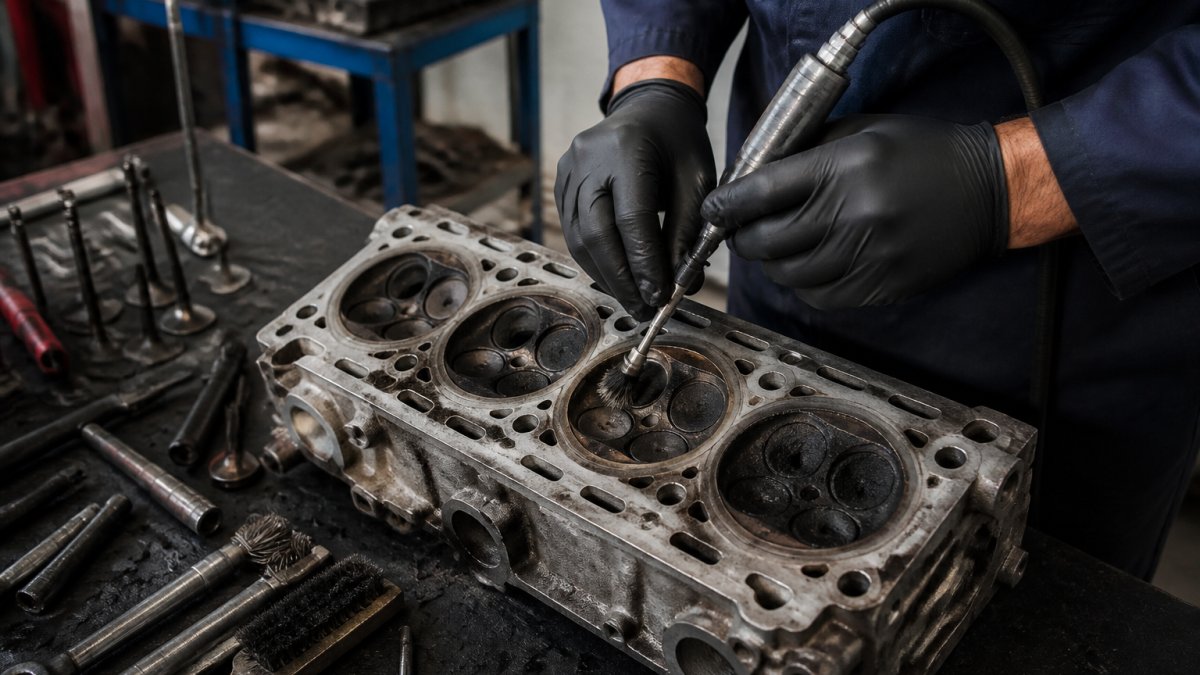
Fuel additives dissolve carbon deposits as fuel passes through your fuel system and combustion chamber, the cheapest option, with no mechanical work. Active chemicals break down carbon bonds and the particles exit as exhaust. Light to moderate deposits respond well, but heavy baked-on carbon on pistons or chamber walls won't dissolve, so additives work best as prevention, not a cure.
Common fuel additive types:
The catch: additives take time. Most need 3-5 fill-ups to show measurable improvement, and they only reach deposits accessible through fuel or oil circulation.
In port-injection engines, fuel injectors spray into the intake manifold, so fuel pools on the valve seat and carbon accumulates faster than it burns. Professional cleaning removes the intake manifold and sprays solvent directly onto the valves and chamber.
Cost: $150-400 depending on engine size and valve count. Results are dramatic for intake valve deposits, rough idle often stops immediately and fuel economy improves.
Direct-injection engines spray fuel at high pressure straight into the combustion chamber, so fuel no longer washes over the intake valves and deposits build faster there.
Cost: $400-800 for a full engine.
Results: Extremely effective for GDI engine carbon cleaning. Deposits vanish, and performance returns.
Drawbacks: labor-intensive, requires specialized equipment not all shops have, and shell media can lodge in crevices if not carefully cleaned afterward.
GDI engines accumulate deposits 5-10 times faster than port-injection engines.
Your cleaning options for GDI engines:
Fuel additives: Prevent future buildup but can't dissolve heavy existing deposits, maintenance, not repair.
Walnut blasting: The proven solution, removing 90%+ of deposits in one service.
Water injection: Water-methanol systems cool combustion and reduce deposit formation, but results are mixed.
Professional chemical cleaning: Pressurized chemical sprays into the intake, less aggressive than walnut blasting but cheaper.
If you own a GDI engine, plan intake valve cleaning around 60,000-80,000 miles.
read more here to understand this technology →
Not all fuel additives are equal. Some work. Others are marketing hype.
What to look for:
Cost comparison: Top-tier gasoline costs 5-10 cents more per gallon. Standalone additives cost $15-40 per bottle and treat 15-20 gallons. Both work, but top-tier gas is cheaper if you fill up regularly.
Safety note: Fuel additives are safe when used as directed. Don't exceed the recommended dose. Modern engines tolerate additives well.
Price alone doesn't tell you which method is right, match it to the engine design, deposit location, and diagnostics.
| Method | Typical cost | Reaches | Best suited to | Effectiveness |
|---|---|---|---|---|
| Top-tier gasoline | A few cents more per gallon | Fuel system, light chamber deposits | All engines, prevention | Low to moderate |
| PEA fuel system cleaner | $10-40 per bottle | Injectors, fuel system, light chamber deposits | Port-injection, light buildup | Moderate |
| Professional chemical intake service | $150-400 | Intake valves, upper chamber | Port-injection, moderate buildup | High for intake valves |
| Walnut blasting | $400-800 | Intake valves | Direct-injection, heavy valve deposits | Very high for intake valves |
| Intake manifold removal and manual cleaning | $200-500 | Intake ports and valves | Both, when access is already open | High |
| Disassembly and mechanical cleaning | $800 and up | Pistons, rings, chamber, valves | Severe deposits, engine already apart | Highest, highest risk |
Two rules of thumb follow from that table:
Cleaning is worth the money when diagnostics point to deposits rather than another fault, the deposits are in a location the chosen method can reach, and the engine is otherwise mechanically sound. It is not worth it when the engine has low compression, a failing head gasket, or a valvetrain fault; when dislodged material could damage the engine; or when the vehicle is near end of life and the cost approaches its value.
A cleaning service should produce measurable change. Before and after, capture:
If none of those change, the original diagnosis was probably wrong.
Prevention is cheaper than any cleaning method. Top-tier gasoline, on-schedule oil changes, a clean air filter, and regular highway driving reduce deposit formation at a fraction of professional service cost. For direct-injection owners, budget for an intake valve service at 60,000-80,000 miles.
Most top-ranking pages skip DIY risks, but improvised forum and video methods can cause real, expensive damage. Here's what goes wrong and where the hard limits are.
Carbon cleaning loosens deposits so they burn off or get pushed out. But liquid introduced into the intake tract is incompressible: if enough enters a cylinder on the intake stroke and the piston rises on compression, something gives. That's hydrolock, it bends connecting rods, cracks pistons, and can destroy an engine in one event.
A few mechanics of failure worth understanding:
Cleaning is maintenance, not repair. Skip it and move to inspection or repair when:
Otherwise, cleaning may temporarily mask a symptom while the underlying fault worsens.
Prevention beats cleaning. Change how you drive and maintain your engine to slow deposit formation.
Driving habits that reduce carbon:
Maintenance steps:
Long-term solutions:
For owners serious about reducing emissions and fuel consumption, HHO generator technology offers a proven alternative. HHOKitsDirect's 5th generation H2XTRME systems act as a combustion catalyst, helping your engine burn fuel more completely while you drive, cleaning carbon deposits over time while improving fuel economy and reducing emissions.
Cleaning engine carbon doesn't have to mean expensive shop visits or risky DIY experiments. Start with diagnosis to confirm deposits exist, use quality fuel and additives for prevention, and for heavy buildup rely on professional cleaning or walnut blasting.
| Cleaning Method | Cost | Best For | Effectiveness |
|---|---|---|---|
| Fuel additives | $10-40 | Prevention, light deposits | Moderate |
| Chemical cleaning | $150-300 | Intake valves, moderate deposits | High |
| Walnut blasting | $400-800 | GDI engines, heavy deposits | Very high |
| Oil additives | $15-50 | Internal surfaces | Moderate |
Common signs include rough idle, hesitation during acceleration, reduced fuel economy, and a check engine light. You may notice the engine running hotter than normal or hear pinging during acceleration. Direct-injection engines are especially prone to intake valve deposits. A mechanic can confirm deposits visually during inspection or through a borescope examination of the combustion chamber.
Fuel additives are the safest starting point for mild deposits, they work passively during normal driving with minimal risk. For moderate buildup, professional intake valve cleaning or fuel injector service is safer than DIY methods. Walnut blasting is effective but requires professional equipment. Avoid water injection or chemical sprays without professional guidance, as improper application can cause hydro-lock or engine damage.
Quality fuel additives can reduce carbon deposits on intake valves over time, especially on port-injection engines. However, they work slowly and cannot remove heavy, stubborn deposits. Direct-injection engines often need mechanical cleaning because fuel doesn't contact intake valves directly. Additives are best used as preventive maintenance or for mild buildup, not as a complete solution for severe carbon accumulation.
GDI (direct-injection) engines typically need cleaning between 60,000 and 100,000 miles if you notice symptoms like rough idle or hesitation. Severe buildup may occur sooner on vehicles driven mostly at low speeds or in stop-and-go traffic. Check your vehicle's service records and monitor performance. If fuel additives don't resolve symptoms after one or two tank treatments, professional walnut blasting or mechanical cleaning is warranted.

Subscribe to our newsletter and always be the first to hear about what is happening.
© 2026 HHOKitsDirect.com
Designed by Out of the Sandbox. Powered by Shopify


Note and Disclaimer: Hydrogen or Hydroxy gas and hydrogen cells are experimental technologies, results vary depending on application success is not guaranteed.
Editorial Team
Author