
Last Updated: October 9, 2026
Fuel costs represent one of the largest operating expenses for truck owners, making the ability to increase truck mpg essential for managing budgets. For commuters and commercial operators, improving fuel efficiency directly impacts monthly budgets and long-term profitability.
Beyond the financial argument, engine emissions contribute significantly to air quality and environmental health. Trucks produce nitrogen oxides and particulate matter that degrade air quality in communities near highways and distribution centers. Improving combustion efficiency reduces these emissions while simultaneously lowering fuel consumption.
The relationship between fuel consumption and engine performance is direct: engines that burn fuel more completely produce more power per gallon while generating fewer pollutants. This is why we focus on practical modifications that enhance combustion efficiency.
Tire pressure directly affects rolling resistance, the force required to keep your truck moving forward. Underinflated tires deform more as they roll, increasing the energy your engine must expend. Even a 5-pound-per-square-inch drop below manufacturer specifications noticeably increases fuel consumption.
Check your truck's door jamb or fuel door for the manufacturer's recommended tire pressure, typically between 30 and 35 PSI for most trucks. Use a quality tire gauge to measure pressure when tires are cold, before driving or at least three hours after driving.
Tire selection also matters. All-terrain and mud-terrain tires provide excellent off-road capability but generate more rolling resistance than highway-focused tires. If you primarily drive paved roads, consider switching to all-season or highway tires to reduce drag.
Your driving behavior influences fuel consumption more than many truck owners realize. Aggressive acceleration and rapid deceleration waste fuel by forcing the engine to work harder and less efficiently. Smooth, gradual acceleration allows the engine to operate in its optimal efficiency zone.
Idle time represents pure fuel waste. Modern truck engines consume fuel while idling without producing any forward motion. Avoid warming up your engine for extended periods; modern engines reach operating temperature faster while driving gently than sitting parked.
Highway speed significantly affects fuel economy. Wind resistance increases exponentially at higher speeds. Driving at 55 miles per hour versus 70 miles per hour can improve fuel efficiency by 15 to 20 percent.
A well-maintained engine operates more efficiently and produces better fuel economy. Clogged air filters restrict airflow to the combustion chamber, forcing the engine to work harder. Replace air filters every 15,000 to 30,000 miles depending on driving conditions.
Spark plugs deteriorate over time, causing incomplete combustion and reduced efficiency. Most trucks require spark plug replacement every 30,000 to 100,000 miles depending on plug type. Worn plugs create weak ignition and waste fuel. Fuel injectors accumulate deposits that disrupt spray patterns and combustion.
Regular oil changes maintain engine lubrication and reduce internal friction. Thicker oil creates more drag within the engine, consuming additional fuel. Using the manufacturer-recommended oil viscosity ensures optimal efficiency. Transmission fluid and coolant also require periodic attention to maintain overall drivetrain efficiency.
HHO generator kits produce hydrogen and oxygen on demand, introducing these gases into the combustion chamber where they enhance fuel burn. The hydrogen acts as a combustion catalyst, enabling more complete burning of gasoline or diesel fuel. This improved combustion efficiency translates directly to increased miles per gallon and reduced emissions.
The technology works by using electrical current to split water molecules into hydrogen and oxygen gases. These gases flow into the air intake, where they mix with incoming air and fuel.
H2XTRME represents the fifth generation of HHO generator technology. The innovation focuses on improving combustion efficiency through optimized hydrogen and oxygen production rates. The generator uses advanced plate configurations and internal design that maximize gas production while minimizing electrical draw.
The system includes a chemically welded, permanently sealed container that eliminates traditional gaskets and bolts. This design prevents leaks and simplifies maintenance. Internal plate retainers eliminate the need for external fasteners, reducing areas where leaks could develop. The result is a more reliable system that requires minimal upkeep once installed.
Engine displacement determines the appropriate kit size. Smaller engines, those under 4 liters, require less hydrogen and oxygen to achieve optimal combustion enhancement. Larger engines, particularly turbocharged diesels exceeding 6 liters, need proportionally more gas production to effectively enhance combustion across the entire fuel burn cycle.
HHOKitsDirect offers the H2XTRME HHO Kit for medium engines from 3.8 to 6.7 liters, priced at $747.00, and the H2XTRME HHO Kit for large engines from 6.8 to 12.0 liters at $897.00. Both kits include the generator, reservoir, filter, hoses, wiring, mounting brackets, and all hardware necessary for installation. Selecting the correct size ensures the generator produces the right volume of hydrogen and oxygen for your engine's displacement.

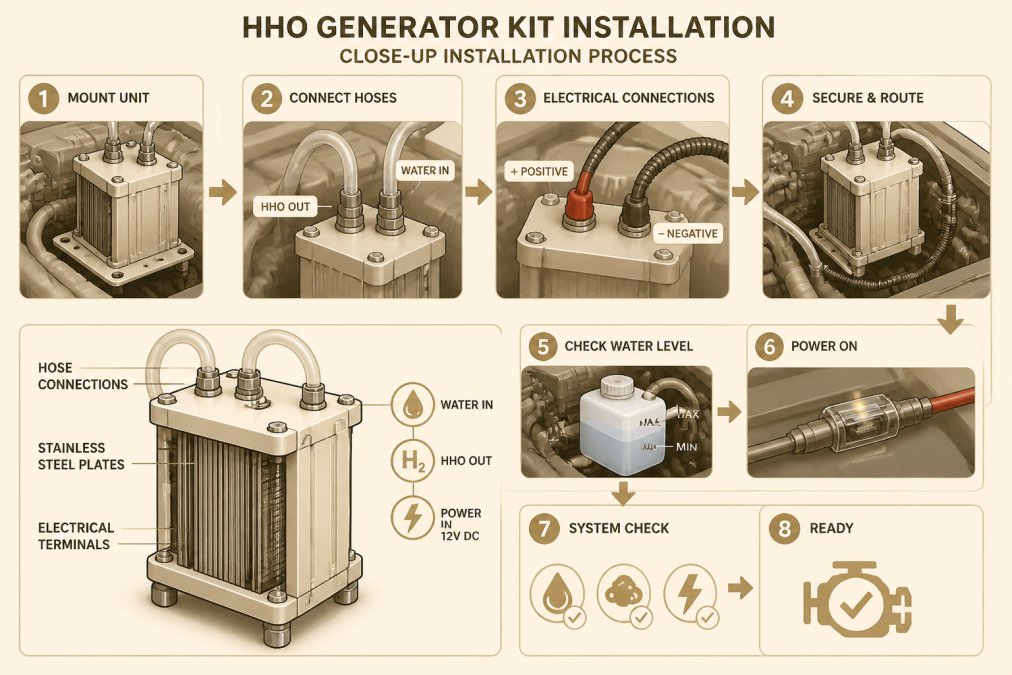
Installation begins with selecting a mounting location, typically in the engine bay where the generator remains protected from excessive heat and moisture. Most installations use the driver's side fender or inner fender well. The generator connects to the battery using two electrical terminals, positive and negative.
Two hose connections complete the system. The inlet hose draws water from the reservoir into the generator. The outlet hose carries hydrogen and oxygen gas into the air intake system.
Installation typically requires two to four hours depending on engine bay layout and your mechanical familiarity. The fully illustrated manual provided with each kit walks through every step. Once installed and filled with distilled water and activator solution, the system activates automatically when the engine starts.
DUAL QUAD CORE Advanced Commercial HHO System For Trucks, Buses, Large Boats →
Beyond HHO technology, several complementary modifications work together to increase truck mpg through different mechanisms. Each works through different mechanisms, but combined they create compounding improvements in miles per gallon.
Synthetic motor oils reduce internal engine friction more effectively than conventional oils. The molecular structure of synthetic oil creates less resistance as it flows through engine passages and around moving parts. Lower viscosity oils, such as 0W-20 instead of 10W-30, further reduce drag, though you must use the viscosity your truck manufacturer specifies to avoid engine damage.
Synthetic oils maintain consistent viscosity across temperature ranges better than conventional oils. They don't thin as much at high temperatures or thicken excessively in cold conditions. This stability means your engine operates at optimal efficiency regardless of ambient temperature.
Air resistance increases exponentially at highway speeds. A tonneau cover over the truck bed reduces turbulence behind the vehicle, lowering aerodynamic drag. Bed covers create a smooth surface rather than allowing wind to swirl inside the open bed, which creates significant drag.
Cab-mounted wind deflectors and side skirts further reduce aerodynamic disruption. These modifications work by smoothing airflow around the truck's profile. Fender flares, running boards, and other protruding accessories increase drag and should be minimized if fuel efficiency is your priority. Lowering the truck slightly reduces frontal area and improves aerodynamics, though this modification affects ride quality and clearance.
Excess weight directly increases fuel consumption. Every additional 100 pounds of cargo requires more energy to accelerate and maintain speed. Remove unnecessary items from the truck bed and cab. Tools, spare parts, and equipment should be stored only when needed.
If you regularly haul heavy loads, distribute weight evenly across the truck bed. Concentrated weight toward the rear affects suspension geometry and increases aerodynamic drag. Consider removing heavy aftermarket accessories like winches or brush guards if they're not regularly used.
Understanding your truck's actual fuel consumption requires accurate measurement. OBD-II diagnostic scanners connect to your truck's onboard computer and display real-time data including fuel trim, mass airflow sensor readings, and calculated fuel economy. These tools reveal how modifications affect engine operation.
Fuel trim values indicate whether your engine is running rich (too much fuel) or lean (too little fuel). The engine computer continuously adjusts fuel delivery based on sensor inputs.
A ScanGauge or similar real-time monitor displays instantaneous MPG, allowing you to see immediate effects of driving technique changes and modifications. Tracking fuel consumption over weeks and months reveals whether modifications deliver measurable improvements. Record your baseline MPG before installing any modifications, then monitor changes afterward.
Cold weather reduces fuel economy by 10 to 20 percent compared to warm weather. Cold engines require richer fuel mixtures to start reliably, and engine oil thickens in cold temperatures, increasing internal friction. Tire pressure drops as temperatures fall, increasing rolling resistance.
In winter, allow your engine to warm gradually while driving gently rather than idling. Use the lightest recommended oil viscosity your manufacturer allows to reduce cold-start friction.
Summer heat also affects fuel economy, though differently. High temperatures can cause fuel to evaporate from the fuel tank and carburetor, wasting fuel. Ethanol-blended gasoline is more prone to evaporation in heat.
Improving truck fuel efficiency requires a comprehensive approach combining maintenance, driving technique, and strategic modifications. Combined with proper tire pressure, preventative maintenance, and smart driving habits, an HHO kit delivers measurable improvements in miles per gallon while reducing emissions and extending engine lifespan.

Results vary based on your truck's condition and which modifications you implement. Tire pressure alone can improve fuel economy by 3-5%. Combining proper maintenance, driving habits, aerodynamic upgrades, and weight reduction typically yields 10-20% improvement. Advanced solutions like HHO generator kits have demonstrated fuel economy gains in field testing, though results depend on engine type, age, and tuning.
Yes. HHO kits are designed for engines across a wide range of ages and sizes. For diesel trucks, you'll need a diesel tuner to adjust fuel trim and MAF/MAP sensors for optimal combustion efficiency. Older engines with higher mileage often see benefits from improved combustion, as HHO acts as a combustion catalyst that helps clean carbon deposits and restore engine performance.
HHO generator kits like those using 5th generation H2XTRME technology produce hydrogen on-demand to enhance combustion efficiency. Unlike fuel additives or simple chips, HHO systems work by improving the actual combustion process, reducing idle time, and lowering engine load. The H2XTRME design uses welded containers and simplified installation with just two electrical terminals, eliminating common gasket and leak issues found in older HHO designs.
Use OBD-II diagnostic tools or a scan gauge reader to monitor real-time fuel trim, mass airflow sensor readings, and throttle response. Track your fuel economy manually by recording mileage and fuel purchases over multiple fill-ups before and after modifications. Winter versus summer comparisons matter, as cold weather reduces MPG by 10-15% due to denser air and longer engine warm-up times.
Check tire pressure monthly and maintain manufacturer specifications. Replace air filters every 15,000-30,000 miles to prevent mass airflow sensor issues. Use synthetic lubricants with proper viscosity to reduce drivetrain drag. If using an HHO kit, maintain the water level in the reservoir and replace filters according to the system's specifications. Regular preventative maintenance prevents engine load from increasing due to carbon buildup.
HHO kits are designed for DIY installation. The H2XTRME generator requires only two electrical connections and two hose connections, making setup straightforward with basic tools. Installation typically takes 2-4 hours. If you're uncomfortable working with electrical connections or fuel system components, professional installation is available. Always consult the fully illustrated manual and follow all safety guidelines.
HHO kits don't reprogram your ECU, so they don't typically void manufacturer warranties. However, check your warranty terms. The advanced diesel tuner adjusts sensor readings (MAF, MAP, IAT, CTS) rather than modifying ECU programming, which minimizes risk. HHOKitsDirect offers a Limited Lifetime warranty on H2XTRME generators, providing protection on the system itself.

Subscribe to our newsletter and always be the first to hear about what is happening.
© 2026 HHOKitsDirect.com
Designed by Out of the Sandbox. Powered by Shopify


Note and Disclaimer: Hydrogen or Hydroxy gas and hydrogen cells are experimental technologies, results vary depending on application success is not guaranteed.
Editorial Team
Author