
Last Updated: October 4, 2026
Drivers searching for the best Hydrox Systems alternative usually share the same frustration: they want lower fuel bills and cleaner emissions, but they are not sure which hydrogen-on-demand kit actually delivers.
The appeal is easy to understand. Fuel prices stay unpredictable, and high-mileage commuters feel every cent.
That is the theory. Here is what most guides get wrong: they blur three completely different product categories under one confusing keyword.
A DIY hydrogen fuel system kit is a complete hardware package that generates hydrogen-oxygen gas on demand and feeds it into your engine's air intake. Nothing is stored or compressed. The gas is produced while the engine runs and used immediately.
Every working kit needs four core components. The generator splits water into hydrogen and oxygen using electricity from your alternator. The reservoir holds the water and activator solution.
Our H2XTRME generators use a chemically welded container with no gaskets, which removes the most common leak point. Installation needs only two electrical terminals and two hose connections.
The tuner is where most buyers get confused. Match it to your fuel system, not your vehicle's age:
| Fuel System | Tuner Option | Notes |
|---|---|---|
| Carbureted (no electronics) | No tuner | Older vehicles |
| Gas, 1987 and newer | Gas tuner | Most common choice |
| All diesels | Diesel tuner | Electronic control engines |
| Gas, advanced results | Pro Series tuner | Requires scan gauge reader |
For drivers who want a hydrox systems alternative without guesswork, our H2XTRME line is the most direct answer. Each kit ships with the generator, reservoir, filter, hose, wire, mounting brackets, and hardware. Sizing comes down to engine displacement, nothing else.
The H2XTRME 882 kit suits 4-6 cylinder cars and trucks. Its 13-plate generator measures 3.5 inches thick, 8 inches wide, and 7.75 inches high. Best for daily commuters who want MPG improvement without a shop visit.

The H2XTRME 883 kit covers large 6-cylinder and 8-cylinder engines up to 6.7 liters. A 19-plate generator, 4.5 inches thick. This is our pick for most half-ton trucks and full-size SUVs.

The H2XTRME 884 kit handles 8-10 cylinder engines, RVs, and heavy trucks. A 25-plate generator, 6 inches thick. For commercial fleets and diesel gensets, we also offer the Dual Quad Core commercial unit.

An HHO generator installation takes most owners an afternoon in a home garage. You do not need to be a mechanic, but you do need to be comfortable with hand tools.
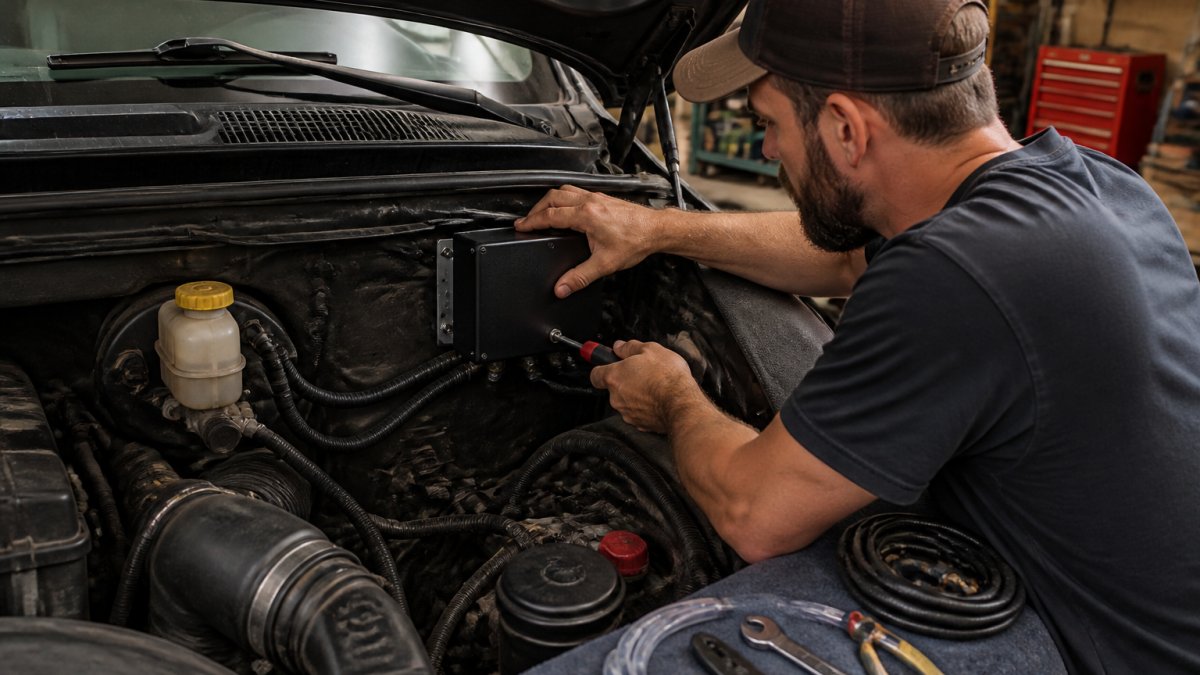
The process follows a clear sequence:
Distilled water plus the supplied activator is all the system needs. On first start, you should see hydrogen and oxygen traveling up the hoses, through the reservoir, then the filter, and into the intake. If flow looks weak, check your electrical connections first.
The benefits of HHO for trucks and RVs come down to combustion efficiency, not magic. Hydrogen-oxygen gas acts as a combustion catalyst: it speeds up the flame front inside the cylinder so more of the fuel charge burns during the power stroke instead of leaving as unburned hydrocarbons out the tailpipe. That single mechanism is what produces every downstream benefit below.
Half-ton trucks, full-size SUVs, and Class A or Class C RVs share one trait: they run heavy, they run long, and they run at steady highway RPM for hours. That duty cycle is where combustion efficiency pays off most, because every gallon is doing more work. Short-trip city driving sees a smaller benefit because the engine spends more time warming up and idling, where combustion quality is already poor regardless of any add-on.
It is not a fuel replacement, and it does not let you delete a fuel system or bypass emissions equipment. It is a combustion aid that supplements the air-fuel charge. Realistic expectations are modest single-digit percentage improvements in fuel economy on highway-heavy duty cycles, with the larger wins coming from smoother operation, cleaner emissions readings, and reduced carbon-related maintenance over time.
NEW! H2XTRME HHO KIT - for SMALL size engines from 1.1 liters to 3.7 liters →
Before you buy any hydrox systems alternative, work through four checks in order: total installed cost, warranty terms, vehicle manufacturer warranty impact, and a realistic cost-per-mile payback estimate. Most guides stop at the first one. The last three are where buyers get surprised.
Our H2XTRME kits run $597 to $897 depending on engine displacement, and every generator carries a limited lifetime warranty. Budget for consumables too: distilled water and activator solution are recurring costs, and a spare filter is worth keeping on the shelf. If you pay a shop to install rather than doing it yourself, add labor on top.
A limited lifetime warranty on the generator is not the same as a warranty on your engine. Read what is excluded. The most common exclusion is running the generator dry, which overheats the plates and shortens generator life. That is a user-error failure mode, and it is the one our lifetime warranty does not cover.
This is the gap in almost every competing guide. Installing an aftermarket fuel system can affect your vehicle manufacturer warranty under the Magnuson-Moss Warranty Act. In plain terms, a manufacturer cannot void your entire warranty just because you added an aftermarket part, but they can deny coverage for a specific failure if they can show the aftermarket part caused it.
Before you install, do three things:
If your vehicle is still under a factory powertrain warranty, weigh that risk against the fuel savings. For an older, out-of-warranty truck or RV, the calculus is much simpler.
Emissions requirements vary by state, and some states with inspection programs are stricter than others. Check your state DMV and your state's emissions program rules before installing anything that touches the air intake or combustion process. The EPA's vehicle and fuel emissions testing information is the right federal starting point, but your state program is what actually governs your inspection.
No honest vendor can quote you a guaranteed MPG gain, because results vary by vehicle, driving style, engine condition, and duty cycle. What you can do is build your own estimate:
Run that math with conservative numbers. If the payback period is longer than you plan to keep the vehicle, the kit is not the right buy for you, and that is a legitimate answer. If it pays back inside a couple of years on a high-mileage highway vehicle, the case is stronger.
Finding the right hydrox systems alternative comes down to one question: does the kit match your engine? Get that wrong and no amount of tuning helps.
HHOKitsDirect builds H2XTRME kits with a chemically welded, gasket-free generator design, simplified two-terminal installation, and a limited lifetime warranty on every generator.
Get started with HHOKitsDirect and match your engine displacement to the right H2XTRME kit today.
The amount scales with engine displacement, which is why kits are sized by liter range. The small H2XTRME unit covers 1.1 to 3.7 liters with a 13 plate generator, the medium unit covers 3.8 to 6.7 liters with 19 plates, and the large unit covers 6.8 to 12 liters with 25 plates. A generator matched to your engine size produces enough hydrogen-oxygen gas to act as a combustion catalyst without overloading the electrical system.
It depends on your annual mileage and your engine size. The small H2XTRME kit costs $597, the medium kit costs $747, and the large kit costs $897, each a one-time purchase with a limited lifetime warranty on the generator. Drivers covering long commutes or hauling loads see the fastest return because fuel savings scale with gallons burned. Low-mileage drivers may take longer to break even, so run your own numbers before ordering.
HHO generators inject hydrogen-oxygen gas into the air intake, and nothing is compressed or stored, so the system does not alter the fuel tank, fuel lines, or ECU programming. The kits work with gasoline, diesel, LPG, CNG, and bio-fuel engines, including carbureted and fuel-injected models. HHOKitsDirect offers a limited lifetime warranty on H2XTRME generators. Check your vehicle's warranty terms before installation if you want written clarity.
The hydrogen-oxygen gas acts as a combustion catalyst. A more complete burn means less unburned fuel and carbon leaving the tailpipe, and the kits also help clean carbon buildup from older engines. Many customers install HHO systems specifically before emissions testing. Results vary by engine condition, so fix any existing fault codes first, then retest after a few hundred miles of driving.
Older generators relied on gaskets, bolts, and exposed plate edges that leaked over time. The H2XTRME design uses a chemically welded, permanently sealed container with no gaskets, internal plate retainers. Installation is reduced to two electrical terminals and two hose connections. These changes cut maintenance and leak points while improving gas production efficiency.

Subscribe to our newsletter and always be the first to hear about what is happening.
© 2026 HHOKitsDirect.com
Designed by Out of the Sandbox. Powered by Shopify


Note and Disclaimer: Hydrogen or Hydroxy gas and hydrogen cells are experimental technologies, results vary depending on application success is not guaranteed.
Editorial Team
Author