
Last Updated: November 17, 2026
Quick Summary
HHO generator cost runs from $597 to $897 at HHOKitsDirect depending on engine size, and payback depends entirely on your fuel price, annual miles, and assumed savings. A $747 kit breaks even in roughly 21 months at a 20% savings assumption, but stretches past three and a half years at 10%.
The hho generator cost vs fuel savings question comes down to a simple test: does the money you spend on a kit come back through the fuel pump? For a deeper ROI and payback-period breakdown, run the numbers yourself. Because HHO kits are sold commercially, it is worth showing the math instead of relying on promotional claims.
Vendor claims run higher. Our advice: run your own numbers before you buy anything.

An HHO generator is an on-demand electrolysis cell that splits distilled water into hydrogen and oxygen gas using current from your vehicle's alternator, then feeds that gas into the air intake. Nothing is stored under pressure, and nothing is compressed.
That alternator draw is the part most buyers miss. Every amp the generator pulls is an amp your engine has to pay for in fuel. Any honest savings figure has to be measured at the wheels, not at the cell.
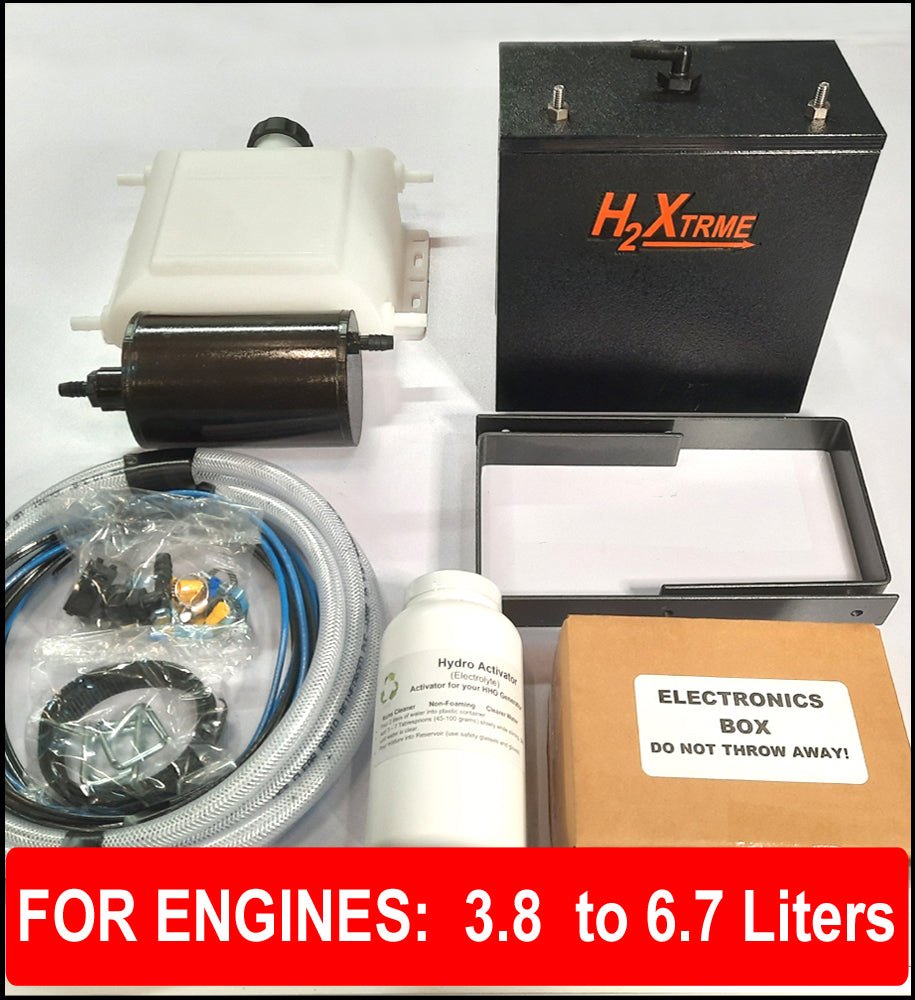
HHO generator price at HHOKitsDirect runs from $597 to $897 depending on engine size. Each kit includes the generator, reservoir, filter, hose, wire, mounting brackets, and hardware needed to install and run it.
HHO PLUS manufacturer fuel-savings claims advertises reductions of up to 30%, but publishes no kit price or test method. That gap matters when you are comparing offers.
| Kit | Engine Range | Plates | Price |
|---|---|---|---|
| H2XTRME Small | 1.1L to 3.7L | 13 | $597 |
| H2XTRME Medium | 3.8L to 6.7L | 19 | $747 |
| H2XTRME Large | 6.8L to 12.0L | 25 | $897 |
Engine Range
Every tier carries a limited lifetime warranty on the H2XTRME generator. See what each complete kit includes before you pick a size.
A savings calculator is only as good as the inputs you feed it, and most online versions quietly omit the one input that decides the outcome: the electrical load the generator places on the alternator. Build the model yourself with five numbers, kit price, baseline MPG, annual miles, fuel price per gallon, and the savings percentage you are willing to assume, and the break-even math becomes checkable rather than promotional.
Start with annual fuel cost: divide annual miles by baseline MPG, then multiply by price per gallon. A vehicle driven 12,000 miles a year at 20 MPG burns 600 gallons; at $3.50 per gallon that is $2,100 in fuel annually. If you assume a 20% reduction, the claimed annual savings are $420, and a $747 kit breaks even in roughly 21 months. At a 10% assumption, savings fall to $210 and break-even stretches past three and a half years. At 5%, it exceeds seven years, longer than many owners keep the vehicle.
Run the same arithmetic at 15,000 miles and $4.00 per gallon and the picture shifts again: 750 gallons, $3,000 in fuel, $600 saved at 20%, break-even near 15 months. The lesson is that break-even is highly sensitive to fuel price and annual mileage, so any single quoted payback figure is close to meaningless without those inputs stated.
Electrolysis is not free energy. The cell draws current from the alternator, and the alternator draws mechanical power from the engine, which the engine pays for in fuel. A common pattern among practitioners is to estimate the added electrical load in watts, convert it to horsepower (roughly 746 watts per horsepower at perfect efficiency, and less in practice), and subtract that parasitic draw from any claimed output benefit before calculating savings. If a kit pulls several hundred watts continuously, the alternator load alone can consume a meaningful share of the claimed gain, which is why a calculator that ignores it will always overstate payback.
| Annual Miles | Baseline MPG | Fuel Price | Annual Fuel Cost | Assumed Savings | Annual Savings | $747 Kit Break-Even |
|---|---|---|---|---|---|---|
| 12,000 | 20 | $3.50 | $2,100 | 20% | $420 | ~21 months |
| 12,000 | 20 | $3.50 | $2,100 | 10% | $210 | ~43 months |
| 15,000 | 20 | $4.00 | $3,000 | 20% | $600 | ~15 months |
| 15,000 | 25 | $4.00 | $2,400 | 10% | $240 | ~37 months |
That is arithmetic, not a promise. Plug your own gallons, price per gallon, and a conservative savings assumption into our MPG math walkthrough, then discount the result for alternator load before you decide whether the kit can pay for itself inside your ownership window.
Watch out: a calculator that accepts a savings percentage without asking for alternator draw, driving mix, or test method is a sales tool, not an analysis, treat its output as an upper bound, not an expectation.
Engine displacement decides which kit you need, and getting it wrong wastes money in both directions. Engines from 1.1L to 3.7L take the Small kit, engines from 3.8L to 6.7L take the Medium kit, and engines from 6.8L to 12.0L take the Large kit.
Check your displacement before ordering, not after. Owners of the 3.8L to 6.7L range can view the medium-engine H2XTRME kit to confirm fit.
Diesel owners have the most to gain and the most to lose. Our diesel tuner option is included with the kit for electronically controlled diesel engines, and kit size should be matched to engine displacement.
Senza Hydrogen's technical explainer notes that HHO gas does not replace fuel burned, which is why we describe it as a combustion catalyst rather than a fuel substitute.
Independent testing is thin, and the results conflict, which is precisely why the quality of the test matters more than the headline number. A Donut Media fuel-economy product test evaluated a $600 HHO generator and reported it ineffective, though the published summary did not include its measurement protocol. A 2025 study by A. Kunaraj and colleagues reported fuel consumption falling from 31.04% to 22.74% after HHO installation, though the abstract does not state the measurement basis. A 2020 study by F. Salek and colleagues found electrode choice could raise generator cost roughly six times versus a DC setup, a reminder that hardware quality drives both price and output. None of these sources, on its own, tells you what your vehicle will do.
A repeatable test controls the variables that move fuel economy independently of any device: route, weather, driving style, tire pressure, vehicle load, and measurement method. The practical protocol most careful owners follow looks like this:
Several factors can explain differences in reported results. Measurement error from hand-calculated MPG can exceed a small claimed gain, test conditions differ between laboratory runs and real commutes, and baseline engine condition can affect how a system performs.
Watch out: a single before-and-after tank reading proves nothing, if the claimed gain is smaller than the tank-to-tank spread you measured during baseline, you have not demonstrated anything yet.
Laboratory and single-vehicle findings establish that an effect is possible under controlled conditions; they do not establish that you will see it on your commute. Independent road tests with published protocols carry more weight than vendor claims, and vendor claims with no stated method carry the least. When you read a savings figure, ask three questions: what was the baseline, how many tanks or test cycles were averaged, and was alternator load accounted for? If any answer is missing, treat the number as a hypothesis rather than a result.
Long-term ownership costs are worth considering before you buy. Budget for distilled water and electrolyte, plus occasional filter changes. The H2XTRME generator uses a welded, permanently sealed container with internal plate retainers that eliminate gaskets.
Warranty risk is real. Some automakers may question aftermarket engine modifications, so read your policy first. Our guide to engine damage and HHO kits covers what to check before you install.
If you are weighing a kit against your monthly fuel bill, the honest answer is that the math only works when the kit is sized right and installed correctly. HHOKitsDirect builds 5th generation H2XTRME generators with chemically welded, permanently sealed housings, internal plate retainers that eliminate gaskets, and a limited lifetime warranty. Get started with HHOKitsDirect and put real numbers behind your fuel savings.
It depends on the kit price, your annual miles, and the savings you actually achieve. A small H2XTRME kit runs $597, and At 20% savings on $2,000 of annual fuel, that is $400 per year, so a $597 kit breaks even in about 18 months. At 10% savings, the same kit takes roughly 3 years.
HHOKitsDirect lists $597 for the small-engine kit, $747 for the medium kit, and $897 for the large kit. Each includes the generator, reservoir, filter, hose, wire, mounting brackets, and hardware. Budget for electrolyte and distilled water over time, plus your own labor or a shop's hourly rate if you do not install it yourself. The commercial DUAL QUAD CORE system is quote-only, so contact the company for pricing and details.
HHOKitsDirect kits are built for diesel, gasoline, LPG, CNG, and biofuel, and diesel owners should choose the diesel tuner option for electronically controlled engines. Diesel fuel costs more per gallon than gasoline, so the same percentage savings translates to more dollars.
Use the HHO generator cost vs fuel savings calculator method: multiply your annual fuel spend by the savings percentage you expect, then divide the kit price by that annual dollar figure. If you spend $2,400 a year on fuel and assume 20% savings, you save $480 annually, so a $747 medium kit pays back in about 19 months. Run the math at 10%, 20%, and 30% to see the range before you commit.
The generator draws electrical load from your alternator, so a small amount of the savings is offset by the energy used to produce the gas. Installation takes time and some mechanical comfort, and a poorly installed unit can trigger check-engine lights. Check your vehicle warranty terms before modifying anything. The H2XTRME generators carry a limited lifetime warranty, which reduces but does not eliminate the risk.

Subscribe to our newsletter and always be the first to hear about what is happening.
© 2026 HHOKitsDirect.com
Designed by Out of the Sandbox. Powered by Shopify


Note and Disclaimer: Hydrogen or Hydroxy gas and hydrogen cells are experimental technologies, results vary depending on application success is not guaranteed.

Editorial Team
Author