
Last Updated: October 2, 2026
A well-maintained engine burns less fuel than a neglected one. At HHOKitsDirect, we see owners chase fancy fixes while ignoring the basics. To improve fuel efficiency for boats, start in the engine bay.
Worn spark plugs waste fuel. Replace them on the schedule in your owner's manual, on most outboard motors and sterndrives, every 100 hours or once a season.
Check these parts often:
Old gear oil adds friction in the lower unit; fresh oil cuts drag and protects the gears. A weak impeller makes the engine run hot, and heat kills fuel economy.
The best cruising speed for fuel efficiency is usually the lowest speed where your boat stays on plane. Push past that, and fuel burn climbs fast. Pull back below it, and you plow water instead of gliding.
A fuel flow meter turns guesswork into data, showing gallons per hour in real time so you can find where miles per gallon peaks.
Here is the simple process:
Three settings control most of your fuel economy: trim, weight, and propeller pitch. Get them right, and you improve fuel efficiency for boats without spending a dime on parts. Get them wrong, and you burn fuel fighting your own hull.
Propeller pitch is the distance a prop would move forward in one full turn, measured in inches. Too little pitch and the engine over-revs; too much and it lugs, wasting fuel and straining the marine engine.
Trim tabs change the angle of your hull in the water. Proper trim lifts the bow, shortens the wetted surface, and cuts hull drag. Less drag means better fuel economy.
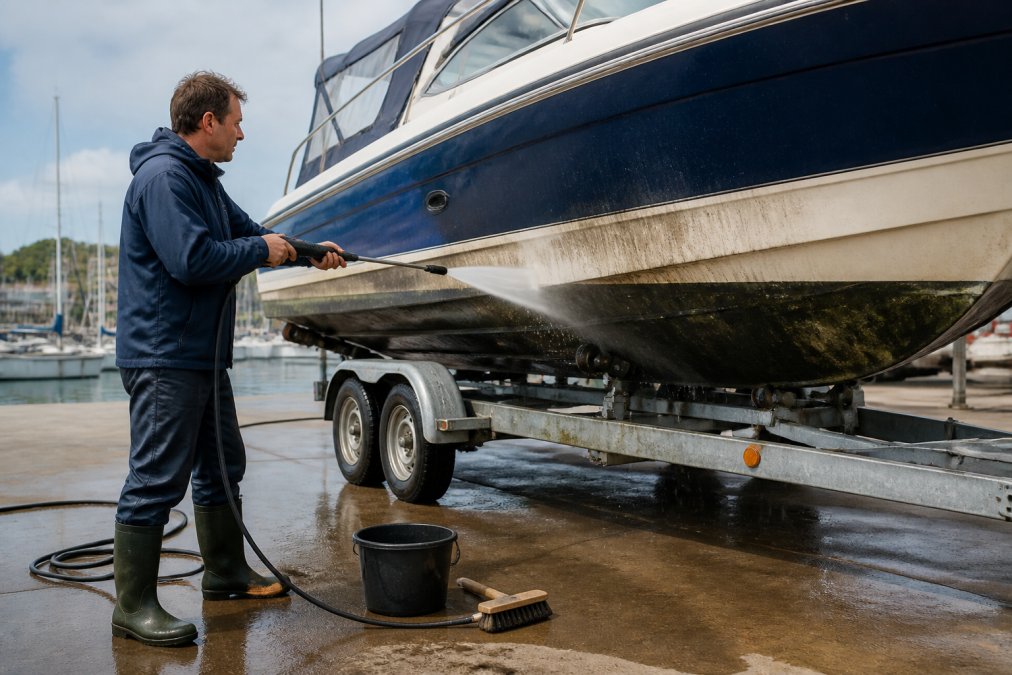
A dirty hull is the silent fuel thief. Barnacles, algae, and slime add drag your engine fights every second; clean the bottom and you often see better fuel economy without touching the engine.
An HHO generator for boat engines adds hydrogen and oxygen gas to the intake air, acting as a combustion catalyst so fuel burns more completely. But the real story is what modern electronic fuel management does with your engine's data.
Most boats built in the last decade support NMEA 2000, the marine networking standard that lets engine, GPS, and display share data over one backbone. A fuel flow sensor reports gallons per hour, and a compatible chartplotter shows it alongside speed, rpm, and trim. Maintaining a stable voltage across this digital backbone is equally critical to ensure that your sensors remain accurate while you extend marine battery life through consistent maintenance routines.
Here is what to watch on the screen:
DUAL QUAD CORE Advanced Commercial HHO →
A diesel tuner or smart controller reads sensor data and adjusts the fuel-air mix. On a modern common-rail diesel, the ECM manages injection timing and duration; a tuner changes the targets it works toward. Paired with an HHO kit, the combustion catalyst helps the ECM hit cleaner burn targets across the load range.
For larger boats, the DUAL QUAD CORE system fits big diesel engines. It uses two large HHO generators, a 2.5-gallon reservoir, four levels of filtration, and a thermostatically controlled cooling fan. A diesel tuner connects to critical sensors for long-term results. Contact HHOKitsDirect for pricing and details on this commercial unit.

Fuel quality, additives, and weather quietly shape your fuel economy, yet most boaters never think about them, the biggest gap in guides that stop at maintenance and trim.
Most pump gasoline in the United States contains up to 10 percent ethanol, sold as E10. Ethanol is hygroscopic, it pulls moisture from the air, and in a vented marine tank that moisture ends up in the fuel. Phase separation happens when the fuel can no longer hold the water: ethanol and water drop to the bottom as a separate layer, leaving the gasoline on top with a lower octane rating.
What that means for efficiency:
Not every additive is worth the shelf space. The ones with a real mechanism behind them:
Weather and water movement change fuel burn more than most boaters realize. A 15-knot headwind can add 10 to 20 percent to your fuel burn at the same throttle setting. A 2-knot foul current can do the same. Neither shows up on a distance-only route plan.
A practical planning method:
Electronic fuel management systems now log much of this for you. NMEA 2000 fuel flow sensors record GPH, engine load, and speed over ground. Review the data after each trip and patterns emerge: the same route burns more on an ebb tide, the afternoon chop costs 8 percent, the headwind leg is the expensive one.
Fuel costs keep climbing, and every wasted gallon hits your wallet twice. Most waste comes from things you control: dirty hulls, wrong props, bad trim, and lazy maintenance. Fix those first, and the gains add up fast.
The 1/3 rule says you should plan to use one-third of your fuel to get where you're going, one-third to get back, and keep one-third in reserve for emergencies or weather changes. It doesn't directly change your boat fuel efficiency, but it forces you to plan routes and load weight more carefully. Running with a lighter, correctly distributed load and avoiding unnecessary detours is one of the simplest ways to cut fuel burn, and the reserve protects you when conditions shift.
Fouled spark plugs, clogged fuel filters, dirty injectors, and worn lower-unit gear oil all force the engine to work harder to produce the same power. That extra work shows up as higher gallons per hour at the same rpm. Following a regular marine maintenance schedule, including oil changes, filter swaps, and cooling system checks, keeps combustion efficiency close to where the manufacturer designed it. Skipping these items is one of the fastest ways to watch your miles per gallon drop over a season.
HHO systems inject hydrogen and oxygen gas into the intake to act as a combustion catalyst, which helps fuel burn more completely. HHOKitsDirect's H2XTRME kits are sized by engine displacement: the 882 kit for 1.1 to 3.7 liters ($597), the 883 kit for 3.8 to 6.7 liters ($747), the 884 kit for 6.8 to 12 liters ($897), and the DUAL QUAD CORE commercial system for large boats and gensets. Each kit includes a tuner option matched to your engine type, and installation uses only two electrical connections and two hose connections.
Yes. Barnacles, algae, and slime increase hull drag, which means the engine has to burn more fuel to hold the same cruising speed. A clean bottom with a fresh anti-fouling coating lets the hull slip through the water with less resistance. For boats kept in the water, a monthly in-water wipe-down and a seasonal haul-out for bottom paint are the two habits that protect boat fuel efficiency the most. Rinse the hull after every saltwater trip to slow growth between cleanings.

Subscribe to our newsletter and always be the first to hear about what is happening.
© 2026 HHOKitsDirect.com
Designed by Out of the Sandbox. Powered by Shopify


Note and Disclaimer: Hydrogen or Hydroxy gas and hydrogen cells are experimental technologies, results vary depending on application success is not guaranteed.
Editorial Team
Author