
Last Updated: September 21, 2026
You cannot lower carbon emissions from your car until you know what you are actually producing. Every gallon of gasoline burned releases about 8,887 grams of CO2, according to the EPA greenhouse gas equivalencies calculator. That number gives you a starting point.
Here is the simple formula:
A driver covering 15,000 miles at 25 MPG burns 600 gallons. That is roughly 5.3 metric tons of CO2e per year.
Most people guess wrong here. They assume the biggest wins come from driving less. In practice, fuel efficiency gains often deliver more per dollar spent.
Write down three numbers: current MPG, annual miles, and annual fuel cost. You will use all three in Step 7.
Basic maintenance is the cheapest way to improve engine fuel efficiency. A dirty air filter, worn spark plugs, and low tire pressure all force your engine to burn more fuel for the same distance.
Start with these:
A common mistake is skipping the oxygen sensor. When it fails, the engine runs rich, and you lose fuel mileage without any warning light at first.
These steps cost little. Together they can recover several MPG on a neglected vehicle.
Hydrogen-on-demand systems are the most direct answer to how to reduce greenhouse gas emissions from cars without replacing the vehicle. An HHO generator uses electricity from your alternator to split water into hydrogen and oxygen gas, then feeds that gas into the intake.

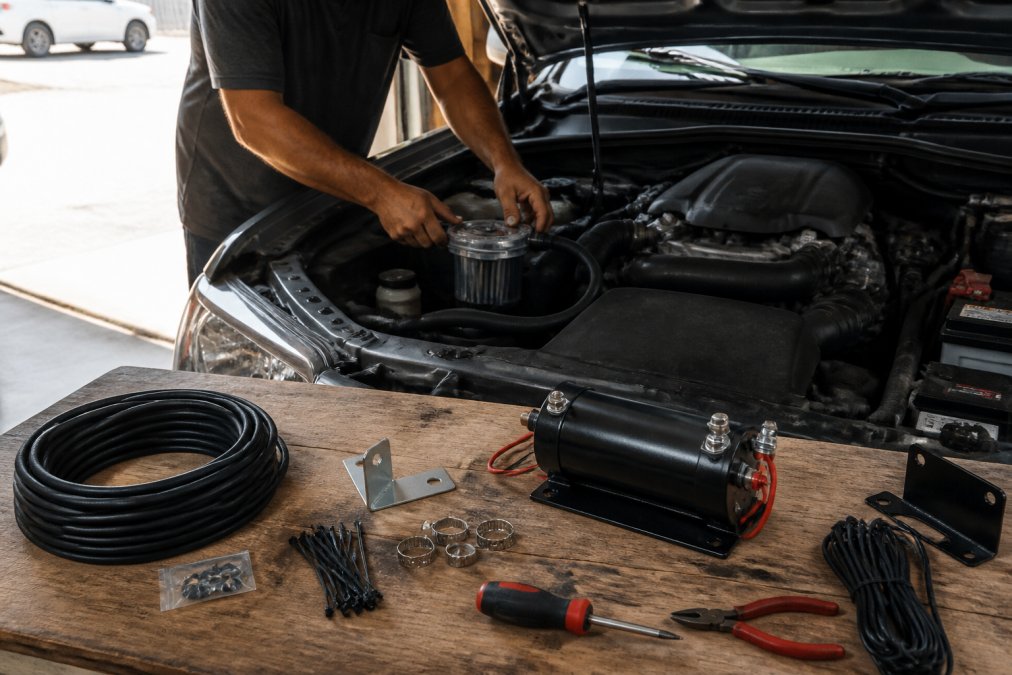
The hydrogen acts as a combustion catalyst. It helps the fuel burn more completely, which means less unburned fuel leaves the tailpipe and more of it produces power.
HHOKitsDirect builds DIY kits around this principle. Their 5th generation H2XTRME generators use a chemically welded, permanently sealed container with no gaskets, plus internal plate retainers that remove common leak points. Installation needs only two electrical terminals and two hose connections.
The U.S. Department of Energy notes that hydrogen can lower carbon emissions when it displaces conventional fuel, though production method matters DOE hydrogen and fuel cell overview.
The HHO generator benefits show up fastest on older, high-mileage engines. These motors carry years of carbon deposits on pistons, valves, and intake surfaces. Those deposits disrupt airflow and reduce combustion efficiency.

A hydrogen feed helps burn off that carbon over time. Owners of trucks, RVs, and long-haul vehicles often report smoother idle and better throttle response after a few thousand miles.
Kit sizing matters more than anything else here:
| Engine Size | Recommended Kit | Price |
|---|---|---|
| 1.1L to 3.7L | H2XTRME 882 (13 plate) | $597 |
| 3.8L to 6.7L | H2XTRME 883 (19 plate) | $747 |
| 6.8L to 12.0L | H2XTRME 884 (25 plate) | $897 |
Each kit ships with the generator, reservoir, filter, hose, wire, and mounting brackets. The H2XTRME line carries a Limited Lifetime warranty on the generators.
Driving habits change your fuel use more than most hardware upgrades. Aggressive acceleration and hard braking can cut highway fuel economy noticeably, and the effect compounds over a full tank.
Try these:
NEW! H2XTRME HHO KIT - for SMALL size →
Sustainable transportation is not only about switching to an EV.
Home and daily choices add up fast, and they cost less than most people expect. The trick is to rank them by impact per dollar rather than by how often they appear on generic lists. A few changes move the needle; many do not.
Home energy and weatherization
Diet
Waste and recycling
Renewable electricity
Water
The prioritization angle most guides skip
Establish a baseline first
Carbon footprinting tools worth using
The ROI math
For any upgrade, the formula is the same:
The psychology problem nobody addresses
Digital footprint, briefly
A few tools help here. Fuel-logging apps track MPG automatically. A scan gauge reader shows live fuel trims and helps you confirm the kit is working. Carbon footprinting tools convert your gallons into CO2e so you can see the environmental impact next to the savings.
The most effective approach combines maintenance, driving habits, and technology. Regular tune-ups, proper tire inflation, and removing excess weight improve engine fuel efficiency. For a bigger impact, an HHO generator kit introduces hydrogen into the combustion process, which acts as a combustion catalyst to help fuel burn more completely. This reduces unburned hydrocarbons and carbon monoxide while improving mileage. Many drivers see the best results by stacking these methods rather than relying on one alone.
Yes, older engines often benefit the most because carbon buildup and incomplete combustion reduce efficiency over time. An HHO kit adds hydrogen on demand, which helps burn off existing carbon deposits and improves the combustion of fuel that would otherwise exit as soot or unburned gas. For a 2008 diesel truck or similar high-mileage vehicle, the kit can restore some lost efficiency and reduce visible exhaust. Choose the tuner option that matches your fuel system (gas, diesel, or carbureted).
Look for real-world mileage data from the manufacturer or other users. HHOKitsDirect publishes a Mileage Results Chart showing actual MPG improvements from customers. You can also track your own before-and-after fuel logs and use an OBD-II scanner to monitor fuel trim and emissions-related codes. A properly installed HHO system with the correct tuner should show a measurable reduction in fuel use over several tanks, which directly translates to lower CO2e per mile.
HHO kits are add-on systems that do not modify the engine's internal components, so they generally do not void a new-vehicle warranty under the Magnuson-Moss Warranty Act. The main risks are improper installation or using the wrong tuner, which can cause check-engine lights or poor performance. HHOKitsDirect kits are designed for simple installation with only two electrical terminals and two hose connections, and they include a Limited Lifetime warranty on the generator. If you are not handy, have a qualified mechanic install it.

Subscribe to our newsletter and always be the first to hear about what is happening.
© 2026 HHOKitsDirect.com
Designed by Out of the Sandbox. Powered by Shopify


Note and Disclaimer: Hydrogen or Hydroxy gas and hydrogen cells are experimental technologies, results vary depending on application success is not guaranteed.
Editorial Team
Author