
Last Updated: November 2, 2026
Quick Summary
An hho generator does not replace a catalytic converter, because the two devices do different jobs. An hho generator adds hydrogen and oxygen to the intake to support combustion, while a catalytic converter converts CO, HC and NOx in the exhaust. A failed converter still fails emissions with a kit installed.
An HHO generator does not replace a catalytic converter.
An HHO generator produces hydrogen and oxygen on demand from water and electricity, then routes that gas into the engine to support combustion.
Below, we break down what each device does, where the research supports the claims and where it does not, and how to decide which fix matches your problem.
| Device | Where It Sits | What It Does | Fixes a Failed Emissions Test? |
|---|---|---|---|
| HHO generator | Engine bay, feeds air intake | Adds H2/O2 gas to improve combustion | Not by itself |
| Catalytic converter | Exhaust system | Converts CO, HC, NOx to less harmful gases | Yes, when it is the failed part |
An HHO generator is an on-demand electrolysis unit. It splits water into hydrogen and oxygen gas using electrical energy from the vehicle's battery or alternator, then sends that gas into the air intake.
A catalytic converter is a pollution-control device in the exhaust stream. The EPA guidance on aftermarket catalytic converters describes it as a vehicle component that converts harmful exhaust gases into less harmful ones through a catalytic reaction.
The distinction matters because they solve different problems. A dead converter is not fixed by an HHO kit, and inefficient combustion is not fixed by a converter.
Water electrolysis is the core process: current passes through stainless steel plates in a sealed cell, splitting water into hydrogen and oxygen. That gas mixture, often called HHO or oxy-hydrogen, travels through a reservoir and filter, then enters the air intake.
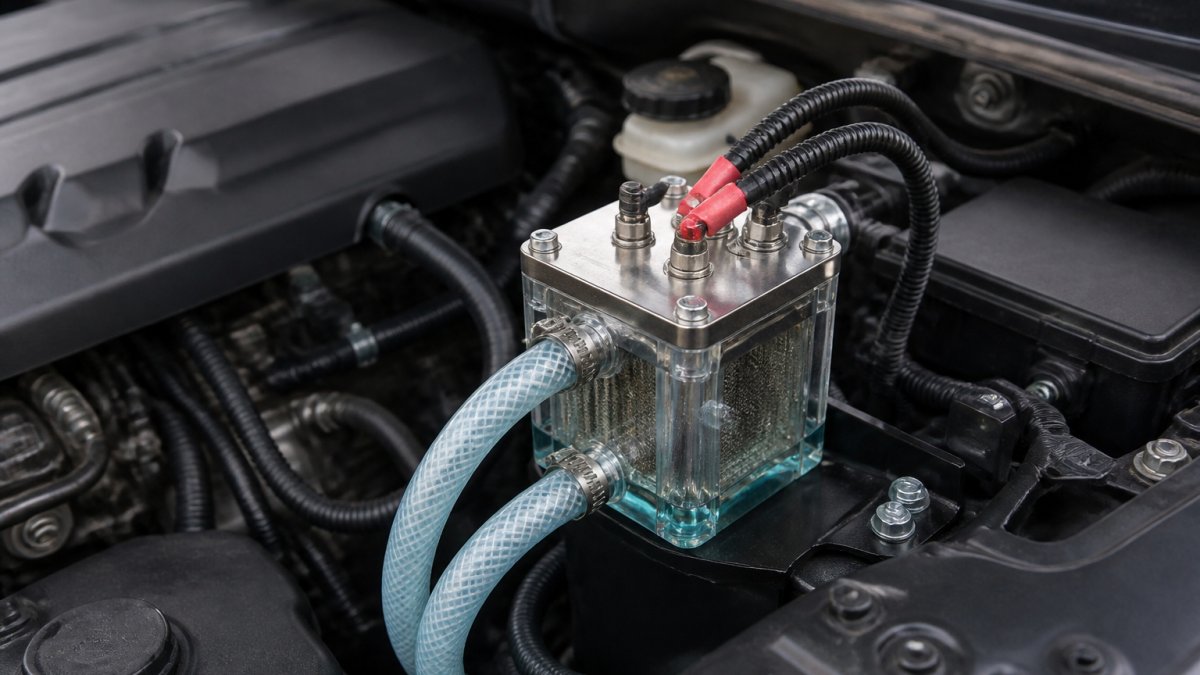
An electrolysis cell holds stacked plates in water and activator. Two electrical terminals connect to the vehicle's charging system; two hoses carry gas out to the reservoir, through a filter, and into the intake.
Our H2XTRME kits use a chemically welded container with internal plate retainers that eliminate gaskets. Installation comes down to two electrical connections and two hoses.
A 2018 study on wet-cell generators with a Ba(OH)2 catalyst reported improved generator performance and reduced exhaust emissions across four vehicles, though the published result gives no numeric effect size (wet-cell HHO generator catalyst study).
The catalytic converter's job is pollutant conversion, and it happens after combustion is over. As exhaust passes through a catalyst-coated substrate, carbon monoxide (CO) is oxidized to carbon dioxide, unburned hydrocarbons (HC) are oxidized to carbon dioxide and water, and nitrogen oxides (NOx) are reduced to nitrogen and oxygen. That is why converters are central to passing a smog check, they are the last line of defense between the engine and the tailpipe.
Not every converter works the same way, and the type matters when you are diagnosing a failure:
A converter that is the wrong type for the application, or a universal-fit unit installed on a vehicle that requires a specific configuration, can pass a visual inspection and still fail the OBD-II catalyst monitor.
The substrate is a ceramic honeycomb, often cordierite, coated with a washcoat of aluminum oxide carrying the precious metals: platinum and palladium for oxidation, rhodium for NOx reduction. The honeycomb provides large surface area; the precious metals do the chemistry.
Converters fail in a handful of predictable ways:
A driver usually notices one or more of these before a scan tool confirms it:
A converter that is merely old is not automatically failed. The OBD-II catalyst monitor compares the downstream oxygen sensor's switching activity to the upstream sensor's; when the downstream sensor switches almost as fast as the upstream one, the converter has lost oxygen-storage capacity and the code sets. That is a measurement, not a guess, which is why proper diagnosis starts with live data, not a parts cannon.
Nothing in the HHO process replaces the catalytic reaction. An HHO generator adds hydrogen and oxygen to the intake charge; it does not create a catalyst, store oxygen the way a converter's ceria washcoat does, or sit in the exhaust stream. A converter that has lost oxygen-storage capacity or had its precious metals poisoned will still fail the monitor with an HHO kit installed.
No. An HHO generator cannot replace a catalytic converter, and no reputable evidence supports that claim. The two devices operate at different points in the system and perform different functions.
If you failed emissions and want to understand what actually moves the needle, read our breakdown of whether HHO helps pass emissions before you spend anything.
Fuel economy claims deserve scrutiny, and we would rather show you the real numbers than repeat vendor hype. The honest answer is that laboratory efficiency and road MPG are not the same measurement.
A 2024 study in Scientific Reports measured 20.06% energy-conversion efficiency for HHO gas generation when the cell stayed below 60 °C, with a maximum of 39.12% under a catalyst condition of 2 to 6 g/L (oxy-hydrogen generator efficiency study).
What does that mean in practice? A generator that runs efficiently produces more gas per watt, which is the variable a kit designer actually controls.
NEW! H2XTRME HHO KIT - for SMALL size engines from 1.1 liters to 3.7 liters →
The market itself is growing. Fact.MR forecasts the HHO generator market rising from USD 1.8 billion in 2026 to USD 3.9 billion by 2036 at a 7.8% CAGR (HHO generator market forecast).
Carbon cleaning claims are where this category gets sloppiest. The mechanism people describe is real in principle: a more complete burn leaves less unburned carbon to deposit on valves and piston tops.
A 2020 experimental study found that injecting only HHO decreased hydrocarbon emissions, which is consistent with more complete combustion. But the same study found nitrogen oxides and carbon monoxide increased, with the CO rise tied to a richer mixture (HHO injection emissions study).
Our view is straightforward. HHO supports combustion. For a deeper look at what decarbonizing with HHO can and cannot do, see our guide on whether an HHO generator cleans carbon.
Before any install, run diagnostics first. A check-engine light, pending codes, or a recent emissions failure means you need to know what is actually broken before adding hardware. Adding an intake-side device to a vehicle with an unresolved exhaust-side fault just gives you two problems to explain.
Modern vehicles run a set of self-tests called readiness monitors, and two of them are directly relevant to this decision:
A scan tool that reads live data, not just codes, is the minimum. Look at upstream and downstream O2 sensor waveforms, fuel trims, and misfire counters before deciding what to buy.
An HHO generator feeds hydrogen and oxygen into the intake, upstream of the throttle body or air filter. The engine computer sees the change through the MAF or MAP sensor and the upstream oxygen sensor, and in closed-loop operation trims fuel to hit its target, so a small HHO addition is usually absorbed by normal fuel-trim authority.
Two implications follow. First, install the generator so gas enters evenly and the vehicle can relearn its trims; a kit that dumps gas in one spot at one rate is harder for the computer to compensate for. Second, do not install on a vehicle with an existing fuel-trim or misfire fault, you will not be able to tell whether the kit or the pre-existing fault caused the code.
Inspection rules vary by state, and the details matter more than the general principle:
Check your state's motor vehicle agency rules in writing before you buy anything. The rules are public, and a five-minute read prevents an expensive mistake.
Keep your installation records, and if a dealer denies a claim, ask for the denial in writing with the specific failure and causal link. A denial that says "aftermarket part installed" without more is weaker than one tying a specific failed component to the modification.
Our H2XTRME generators carry a Limited Lifetime warranty. That warranty covers the generator, not the vehicle, read both documents before you install.
If you are chasing a P0420 and considering an HHO kit at the same time, fix the P0420 first. The catalyst monitor is a measurement of converter oxygen-storage capacity; no intake-side device changes that measurement, and an unresolved code will follow you into the inspection lane.
For the emissions side of the checklist, our DIY guide to reducing vehicle carbon emissions walks through the practical steps.
Engine displacement decides which kit fits, and picking the right one is the difference between a clean install and a return.
| Kit | Engine Range | Plates | Price |
|---|---|---|---|
| H2XTRME 882 Small | 1.1 L to 3.7 L | 13 | $597.00 |
| H2XTRME Medium | 3.8 L to 6.7 L | 19 | $747.00 |
| H2XTRME Large | 6.8 L to 12.0 L | 25 | $897.00 |
| Dual Quad Core Commercial | Trucks, buses, RVs, gensets | Two quad cores | Contact for pricing |
A four- to six-cylinder car or small truck matches the small-engine H2XTRME kit. Big V8s, RVs, and heavy trucks take the large-engine H2XTRME kit, covering 6.8 to 12.0 liters.


Every kit ships with the generator, reservoir, filter, hose, wire, brackets, and hardware.
The real challenge is not choosing between an HHO generator and a catalytic converter.
HHOKitsDirect builds 5th generation H2XTRME kits with chemically welded, permanently sealed containers, internal plate retainers that eliminate gaskets, and simplified two-terminal, two-hose installation.
They do opposite jobs in different places. An HHO generator uses electricity from your battery or alternator to split water into hydrogen and oxygen, then feeds that gas into the air intake as a combustion catalyst. A catalytic converter sits in the exhaust stream and converts carbon monoxide, hydrocarbons, and nitrogen oxides into less harmful gases. One works on the intake side before combustion; the other works after it. Neither one performs the other's function, and no research shows an HHO generator doing a converter's job.
No. An HHO generator adds hydrogen and oxygen to the intake air; it does not sit in the exhaust and does not convert pollutants. The EPA treats the catalytic converter as the vehicle's pollution-control device and sets rules for aftermarket converters. A 2020 experimental study also found that injecting only HHO raised NOx and CO emissions while lowering hydrocarbons, so removing a converter to fit an HHO kit would work against emissions compliance, not toward it.
The evidence is mixed and mostly from lab work, not road tests. HHOKitsDirect publishes a Mileage Results Chart from customers, but treat any single MPG figure as a claim to verify against your own driving.
Do not count on it, and do not remove your catalytic converter to find out. A 2020 study found HHO-only injection increased NOx and CO emissions, and a 2026 Scientific Reports paper compared measured results with claims made by HHO vendors and engine-cleaning services. If your vehicle failed a test, diagnose the converter, oxygen sensors, and fuel trim first. An HHO kit is a combustion-side add-on, not a repair for a failed converter, and a missing converter guarantees a failure.
The gas is produced on demand and used immediately, so nothing is compressed or stored. Installation on an H2XTRME kit is two electrical terminals and two hose connections, with the container chemically welded and gaskets eliminated to reduce leak points. The real risks are installation errors and warranty questions, so check your vehicle warranty terms before you start. HHOKitsDirect offers a limited lifetime warranty on H2XTRME generators.

Subscribe to our newsletter and always be the first to hear about what is happening.
© 2026 HHOKitsDirect.com
Designed by Out of the Sandbox. Powered by Shopify


Note and Disclaimer: Hydrogen or Hydroxy gas and hydrogen cells are experimental technologies, results vary depending on application success is not guaranteed.

Editorial Team
Author