Last Updated: October 30, 2026
Quick Summary
The best engine tuning tools for 2026 are matched to your ECU family, sensor architecture and skill level rather than the longest feature list. Start with a $40-$150 OBD-II scanner showing live fuel trim, then choose a sensor-signal controller ($69-$275) or paid tuning suite based on the job. Confirm your ECU part number and O2 sensor count before buying.
The global engine tuner market is projected to reach US$4.3 billion in 2026 and US$6.1 billion by 2033, according to Future Market Insights' engine tuner market forecast. That growth tells you one thing: more drivers are treating the ECU as a tuning surface, not a black box. At HHOKitsDirect, we see the same pattern in the questions customers send us before they buy a hydrogen kit.
Three things separate a tool worth owning from a drawer ornament: whether it can read and write the signals your ECU actually uses, whether it supports your make and model year, and whether total cost of ownership stays sane once you add the extras.
Watch out: buying a tuner before confirming your oxygen sensor and MAP/MAF setup is the most common and most expensive mistake here. A narrowband-only unit on a wideband vehicle does nothing useful.
The best ECU programming tool for a car is the one that matches your ECU family, your sensor architecture, and your skill level, not the one with the longest feature list.
Here is the checklist we would use before spending a dollar:
For HHO users specifically, the tuner does not rewrite the ECU fuel map. Our EFIE, MAF, and diesel tuners modify sensor signals so the engine management system trims fuel on its own terms.
Free tuning software is useful for diagnostics and data logging, but its write access, ECU coverage and support vary widely. Paid platforms differ in ECU support, write protocols and technical support. Before committing to any tier, compare the total cost over several years rather than the upfront price.
Most buyers conflate four different products under the word "software." They are not interchangeable, and the licensing model tells you which tier you are in:
| Cost Component | Free Diagnostic App | Open-Source Package | Vendor-Locked Suite | Credit-Based Platform |
|---|---|---|---|---|
| Software upfront | $0 | $0 | One-time license or annual fee | $0 to start |
| Required cable or dongle | Generic OBD-II adapter, $20-$150 | Generic cable, $30-$200 | Vendor cable, often $150-$400 | Vendor interface, varies |
| Ongoing subscription | $0 | $0 | Annual renewal, varies | Per-vehicle credits |
| Per-vehicle cost | $0 | $0 | $0 after license | Credits per flash |
| Support | Community forums | Community forums | Vendor support line | Vendor support line |
| Write access to late-model ECU | No | Sometimes | Yes, within supported list | Yes, within supported list |
| Recovery mode if flash fails | Not applicable | Rarely | Usually | Usually |
For a single-vehicle DIY owner, free diagnostic software plus a dedicated hardware controller is often the smarter spend: the app handles code reading, live data, and log export, while the controller handles signal modification. You skip the subscription and keep a stock baseline, but you are your own support line, so budget time for forums and documentation.
A shop touching dozens of vehicles a month needs three things free software cannot reliably provide: a supported ECU list covering the makes on the lot, a recovery mode that survives an interrupted flash, and a support line that answers during business hours. If you cannot name the ECU families you will touch in the next 12 months, you are not ready to choose a paid tier.
For HHO users, the tuner does not rewrite the ECU fuel map. Our EFIE, MAF, and diesel tuners modify sensor signals so the engine management system trims fuel on its own terms, keeping factory programming intact. The software decision is therefore simpler: you need a scanner showing live fuel trim and oxygen sensor voltage, not a write-capable tuning suite. A $40-$150 scanner displaying short- and long-term fuel trim is the highest-value software-adjacent purchase here, and it pairs with any of our sensor-signal controllers.
| Option | Upfront Cost | Ongoing Cost | Best For |
|---|---|---|---|
| Free diagnostic software | $0 | $0 | Reading codes, logging data |
| Paid tuning suite | Varies by license | Subscription renewals | Multi-vehicle shops |
| Sensor-signal controller | $69-$275 | None | HHO and fuel-trim tuning |
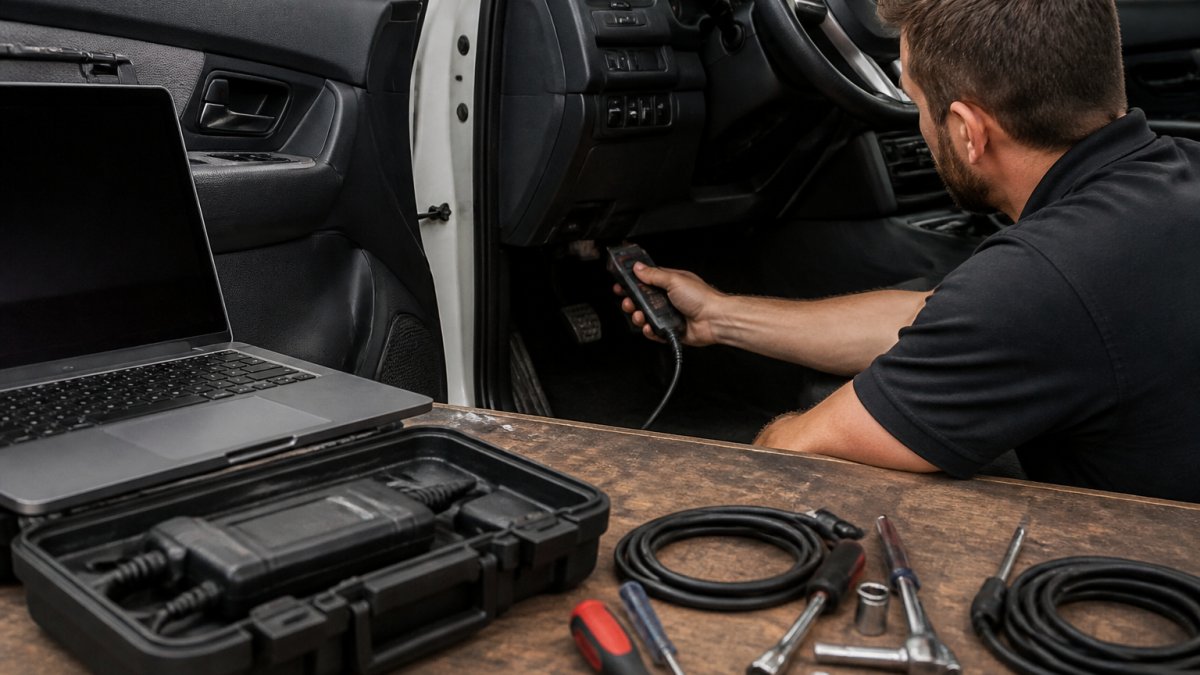
An OBD-II scanner for performance tuning is not optional equipment.
The OBD-II port gives you live data: short- and long-term fuel trims, oxygen sensor voltage, intake air and coolant temperature, and mass airflow readings.
Our Pro Series tuner documentation is blunt: dialing in sensor control properly requires a scan gauge or comparable OBD2 reader. That is a workflow requirement, not a sales pitch.
Start with a scanner and a course, not a flash tool. Beginners who buy a programmer first usually end up paying someone else to fix the result.
The learning order we recommend:
New programmable PRO SERIES Gas and Diesel Tuner for HHO kits →
If you are heading toward hydrogen supplementation, our 8 day expert course on hydrogen and HHO kits walks through sensor interactions before you touch hardware.
HHO controller pricing in the catalog runs from $69 to $275.
| Product | Price | What It Controls |
|---|---|---|
| 40 AMP PWM power controller | $69.00 | Pulsed current to the generator |
| Heavy Duty 40 amp PWM | $89.00 | Current plus frequency, larger cells |
| New 55 Amp CCPWM controller | $150.00 | Constant current, thermal protection |
| EFIE/MAF Advanced Gas Tuner | $175.00 | Up to 4 O2 sensors plus MAF/MAP |
| Advanced Diesel Tuners | $175.00 | MAF/MAP, IAT, and CTS on diesel |
| New programmable PRO SERIES tuner | $240.00 | Narrow/wideband O2, MAP/MAF, IAT, CTS |
| EFIE/MAF PRO SERIES tuner | $275.00 | Full sensor suite, needs scan gauge |
Two of these are currently sold only with full kit purchases due to high demand.
Vehicle compatibility is where most buying decisions actually get made, and where most generic guides stay vague. For applying performance improvements to your specific vehicle and setup, see this enthusiast's guide to improving engine performance.
Diesel splits differently. Electronically controlled diesels with a MAF/MAP, IAT, or CTS sensor need a diesel-specific tuner. Mechanically controlled diesels need nothing electronic.
A generic year chart will get you close, but it will not tell you whether your specific ECU can be written to or which sensor channels your tuner needs to touch. Build a four-column matrix before you buy anything:
| Column | What to Record | Where to Find It |
|---|---|---|
| Model year and engine code | Exact year, displacement, and engine family code | Door jamb sticker and underhood label |
| ECU part number | The full part number on the ECU casing | ECU label, or a scan tool that reports ECU ID |
| Sensor architecture | Count of O2 sensors, narrowband vs wideband, MAP vs MAF, IAT and CTS present | Visual inspection plus live-data scan |
| Tool requirement | Which tuner channels and which software tier the above implies | Vendor compatibility list, confirmed in writing |
Manufacturers routinely swap ECU families mid-year without changing the model year, so a chart keyed only to model year can be wrong at the margins. The ECU part number is the stable identifier, if a vendor's list shows only makes and years, ask for the ECU part number list before buying.
The number of oxygen sensors and whether they are narrowband or wideband determines how many channels your tuner must modify. A single-sensor vehicle needs a basic unit; a four-sensor vehicle with a wideband primary needs a controller handling all four channels plus MAF or MAP. Buying a narrowband-only unit for a wideband vehicle is the most common and most expensive mistake here, because it cannot interpret the signal the ECU actually reads.
| Sensor Setup | Tuner Channels Needed | Typical Match |
|---|---|---|
| One O2 sensor, narrowband, MAP present | One O2 channel plus MAP | Basic EFIE unit |
| Two O2 sensors, narrowband, MAF present | Two O2 channels plus MAF | Advanced EFIE/MAF tuner |
| Four O2 sensors, wideband primary, MAF or MAP | Four O2 channels plus MAF/MAP, IAT, CTS | PRO SERIES tuner |
| Diesel with MAF/MAP, IAT, CTS | MAF/MAP, IAT, CTS channels | Diesel-specific tuner |
| Mechanically controlled diesel | None | No electronic tuner applies |
Compatibility is not only about whether a tool can talk to your ECU. It is also about whether the change is safe and legal where you drive. Three practical rules:
The matrix answers "will it communicate." The next question is "will it do the job." A diagnostic-only scanner reads codes and live data but cannot modify signals. A sensor-signal controller modifies signals but does not flash the ECU. A full tuning suite writes calibration data but is overkill for an HHO setup needing only fuel-trim compensation. Decide the job first, then use the matrix to confirm the tool reaches your ECU and sensor channels.
The right first purchase depends on one question: are you tuning fuel delivery, or supplementing combustion? Browse the full product catalog to choose your first tuner and related kit components. If it is the second, the tuner exists to keep the engine management system happy while the hydrogen does its work, and the sensor count on your vehicle decides which unit you need.
There is no single answer because it depends on your vehicle's ECU and what you plan to change. A dedicated flash tool handles full ECU remapping, while an EFIE-style tuner like the PRO SERIES Gas and Diesel Tuner ($240) modifies sensor signals on cars running an HHO system without touching ECU programming. Check your O2 sensor type (narrowband or wideband) and whether your car uses MAF or MAP before buying anything.
An ECU tuner writes changes to fuel and timing maps or adjusts sensor signals. An OBD-II scanner reads and clears codes and shows live data such as fuel trims and sensor voltages. Most professional workflows use both: the scanner confirms what the engine is doing, and the tuner changes it. HHOKitsDirect's PRO SERIES tuner listing specifically recommends a scan gauge or OBD2 reader to dial in the sensor adjustments.
They can, when the tool corrects an air/fuel ratio that is running richer than needed. HHOKitsDirect's EFIE and MAF/MAP tuners adjust oxygen sensor and MAF/MAP signals to lean the fuel flow, and the diesel tuner adds IAT and CTS adjustment for the same purpose. Gains depend on the vehicle and setup, so log your baseline mileage before installing anything and compare over several tanks.
Start with your fuel system and sensor count. Gasoline vehicles from roughly 1987 to 1996 use only part of the Advanced EFIE/MAF tuner's features, while newer fuel-injected cars use most of them. The QUAD EFIE covers up to four O2 sensors: one front and one rear setting on a 4-cylinder, all four on a 6- or 8-cylinder. Electronically controlled diesels need the Advanced Diesel Tuner, which the listing says works with 95% of diesel vehicles using HHO kits.
Confirm four things: your O2 sensor type (narrowband or wideband), whether you have MAF or MAP, whether the engine is gasoline or electronically controlled diesel, and your system voltage (12V or 24V). Also budget for extras. A PWM controller such as the 40 AMP unit ($69) gives precise current control, and the PRO SERIES tuner requires a scan gauge to tune properly. Add those costs before comparing total price.
The challenge is not finding a tuner. It is buying the one that matches your sensor architecture before you spend money twice. HHOKitsDirect builds 5th generation H2XTRME generators with chemically welded, permanently sealed containers and internal plate retainers that eliminate gaskets, paired with tuners that modify sensor signals without touching your ECU programming. Get started with HHOKitsDirect and match your first tuner to your vehicle correctly.

Subscribe to our newsletter and always be the first to hear about what is happening.
© 2026 HHOKitsDirect.com
Designed by Out of the Sandbox. Powered by Shopify


Note and Disclaimer: Hydrogen or Hydroxy gas and hydrogen cells are experimental technologies, results vary depending on application success is not guaranteed.

Editorial Team
Author