
Last Updated: November 26, 2026
Quick Summary
The Fuel Genie hydrogen injection kit is an aftermarket on-demand system that uses electrolysis to feed hydrogen and oxygen into an engine's air intake, supplementing rather than replacing gasoline or diesel. No independent, controlled test of the Fuel Genie system appears in the public record, so treat mileage claims as unverified.
The Fuel Genie hydrogen injection kit is an aftermarket on-demand hydrogen system that uses electrolysis to feed hydrogen and oxygen gas into an engine's air intake.
Hydrogen injection is not a fuel replacement. The gas produced is supplemental, drawn in with the air charge and burned alongside gasoline or diesel. Proponents describe it as a combustion catalyst. Skeptics point out that no independent, controlled test of the Fuel Genie system appears in the public record, and the one widely cited test of gas-saving devices by Consumer Reports concluded they don't work, though that testing dates to 2012.
So what should a shopper do with a claim that large and evidence that thin? Treat it as a starting point, not a promise. Below, we break down the components, the physics, the price math, and how to match a kit to your engine.
A typical HHO kit contains a generator cell, a water reservoir, a bubbler or filter, hoses, wiring, a control relay, and mounting hardware. The generator is the heart: stacked plates, often described as a titanium core or stainless steel plates, sit in distilled water and an electrolyte activator.
Apply current and the plates split water into hydrogen and oxygen. The gas travels through the reservoir and filter before entering the air intake.
Hydrogen injection kits work by generating hydrogen and oxygen on demand through electrolysis, then routing the gas into the engine's air intake where it mixes with the incoming air charge and enters the combustion chamber. The engine burns that mixture along with its normal fuel.
Electrolysis is the process of using electrical current to split water molecules into hydrogen and oxygen gas (Hydrogen Production: Electrolysis). In a vehicle kit, the alternator supplies the current, so the system adds a small electrical load while it runs.
From the generator, gas passes through a bubbler that traps moisture and a filter that catches fine water vapor. It then enters the air intake upstream of the throttle body. Inside the combustion chamber, the theory is that hydrogen's fast flame speed helps the fuel charge burn more completely, cutting unburned fuel and carbon deposits.
The honest answer is that results vary widely, and no controlled, independently verified test of the Fuel Genie system has been published.
But a mileage gain is not guaranteed, and anyone promising a fixed percentage on every vehicle is overselling.
Watch out: buying a kit purely on a claimed MPG number, without a baseline measurement of your own fuel consumption, leaves you with no way to verify anything. Log three tanks of normal driving first. That baseline is the only honest yardstick you will have.
Owner feedback on the Fuel Genie hydrogen injection kit is thin and hard to verify. Without a baseline, no testimonial, positive or negative, tells you what the kit did on that vehicle.
Three things corrupt owner-reported MPG numbers. First, the placebo effect: a driver who spends several hundred dollars and an afternoon installing a kit expects a result, and expectation changes driving behavior. Second, seasonality: fuel economy swings with ambient temperature, winter blend gasoline, and tire pressure, so a before-and-after comparison across months can show a gain or loss that has nothing to do with hydrogen. Third, trip mix: a driver who adds highway miles during the test period will beat a city-heavy baseline every time.
A common pattern in forum threads is a single tank-to-tank comparison with no record of gallons, miles, or driving conditions. That is an anecdote, not data. Treat any review without a logged baseline as a story about the owner's expectations, not about the product.
If you want to know what a kit does on your vehicle, build the record yourself. Use the same pump, the same octane, and the same tire pressure for every fill. Record odometer miles and gallons at each fill, and calculate miles per gallon by hand rather than trusting the dashboard display, which can be optimistic. Log at least three tanks before installation and three after, and note the percentage of highway versus city miles in each period. Keep the driving mix within a few percentage points between the two phases, or the comparison is void.
A scan tool that logs fuel trims and intake air temperature adds a second layer: if the engine computer is compensating for the added gas by trimming fuel, you will see it in the short- and long-term fuel trim numbers. That is the closest a home tester can get to a controlled experiment without a dyno.
Ask any seller for vehicle-specific records: a dyno pull before and after, a fuel log with dates and odometer readings, and the test conditions. A single testimonial with a percentage and no supporting log is marketing. A spreadsheet with gallons, miles, and dates is evidence. If a seller cannot produce the latter, assume the claim is unverified.
We do not publish a verified figure for this specific product, so confirm it directly with the seller before you budget. What we can do is show you how to run the payback math yourself, because that is where most buyers get surprised.
The sticker price is only the first line. Add shipping, any required tuner module for a fuel-injected or electronically controlled diesel engine, distilled water and electrolyte activator on an ongoing basis, and your time or a shop's labor if you do not install it yourself.
Payback is kit cost divided by monthly fuel savings. Monthly fuel savings is your monthly fuel spend multiplied by the savings rate you actually achieve. Work an example with round numbers: if you spend $200 a month on fuel and the kit delivers a 5 percent gain, you save $10 a month. A $600 kit then takes 60 months, five years, to break even, before maintenance and before the electrical load from the alternator, which itself costs a small amount of fuel. At a 10 percent gain the same kit breaks even in 30 months. At zero gain it never does.
That math is why the savings rate is the only number that matters, and why you must measure it rather than accept a claim. A 2 percent real-world result stretches the same kit past 12 years. The gap between claim and measurement is the entire investment case.
High-mileage drivers win this math and low-mileage drivers lose it, because savings scale with fuel burned. A commuter burning $300 a month reaches break-even roughly twice as fast as a weekend driver burning $150. Before buying, pull your last three months of fuel receipts, average the monthly spend, and run the calculation at 2, 5, and 10 percent savings. If the kit only pays back at the optimistic rate, you are buying a hope, not a return.
For a deeper look at the math, our breakdown of HHO generator cost versus fuel savings walks through the payback calculation step by step.
Compatibility comes down to three things: fuel type, engine displacement, and whether your vehicle has electronic fuel injection.
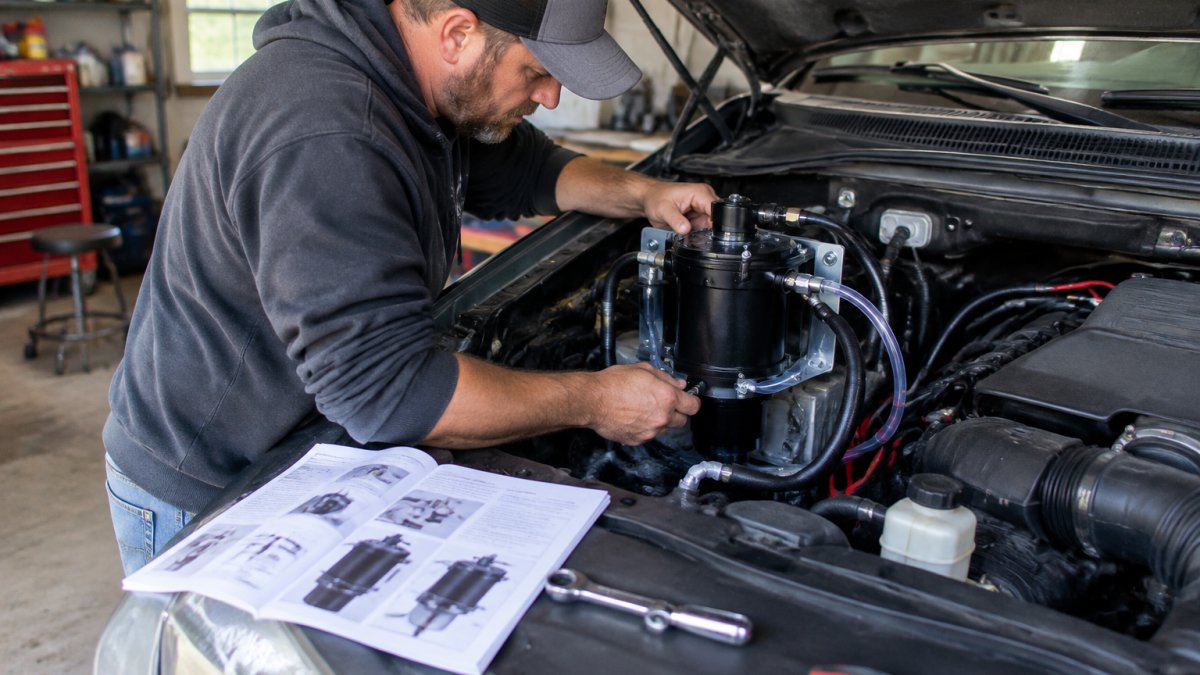
Displacement decides which kit size fits. Small engines from 1.1 to 3.7 liters take a smaller cell; medium engines from 3.8 to 6.7 liters need more plate area; large engines from 6.8 to 12 liters need the biggest generator. For a small-engine fit, you can browse the H2XTRME small-engine kit and check the 13-plate specs. Owners of modern gas or diesel vehicles can also compare EFIE, MAF, and diesel tuner options, since a tuner is usually required from 1989 onward.
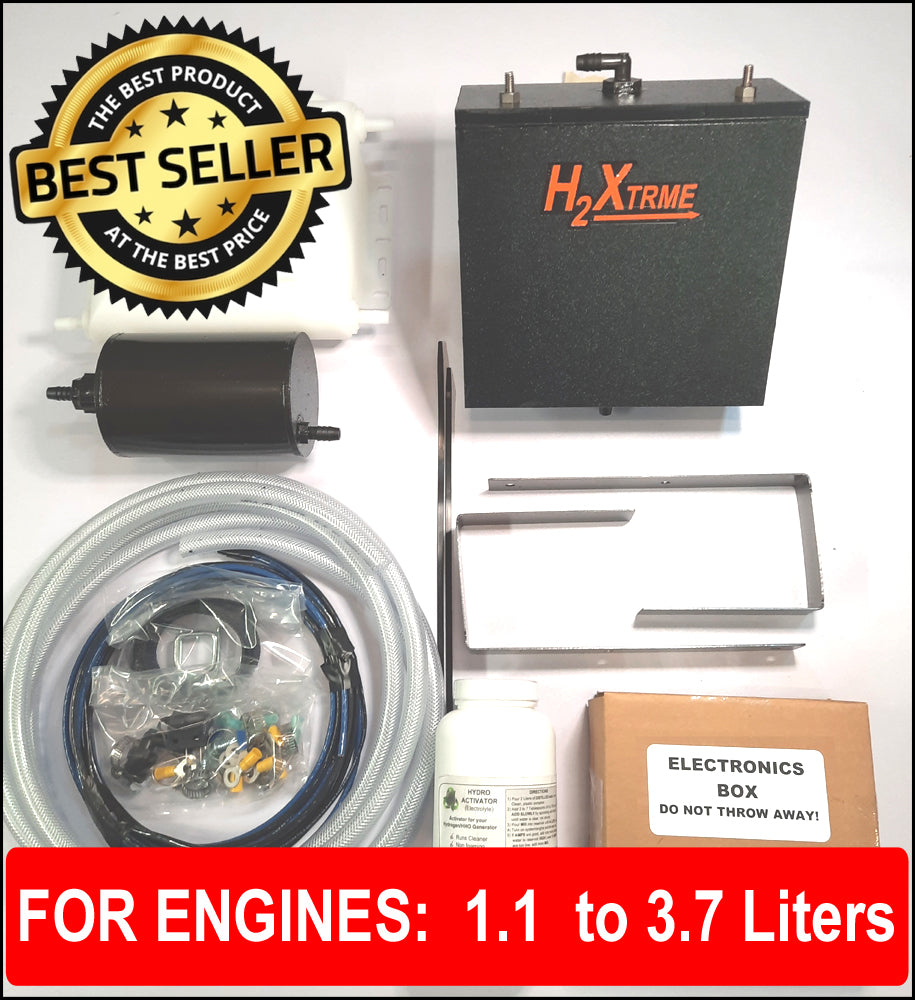
Our H2XTRME line splits by displacement. Each kit ships with the generator, reservoir, filter, hoses, wiring, brackets, and hardware, and each generator carries a limited lifetime warranty.
| Kit | Engine Range | Plates | Price | Best For |
|---|---|---|---|---|
| H2XTRME Small | 1.1 to 3.7 liters | 13 | $597.00 | 4-6 cylinder cars and small trucks |
| H2XTRME Medium | 3.8 to 6.7 liters | 19 | $747.00 | Large 6-cylinder and V8 up to 6.7 liters |
| H2XTRME Large | 6.8 to 12 liters | 25 | $897.00 | V8, V10, and RV engines |
Engine Range
The small kit's sealed, chemically welded container eliminates gaskets and needs only two electrical connections and two hose connections. The medium-engine H2XTRME kit steps up to 19 plates in a 4.5-inch-thick housing. For V8 and RV owners, the large-engine H2XTRME kit runs 25 plates in a 6-inch housing.
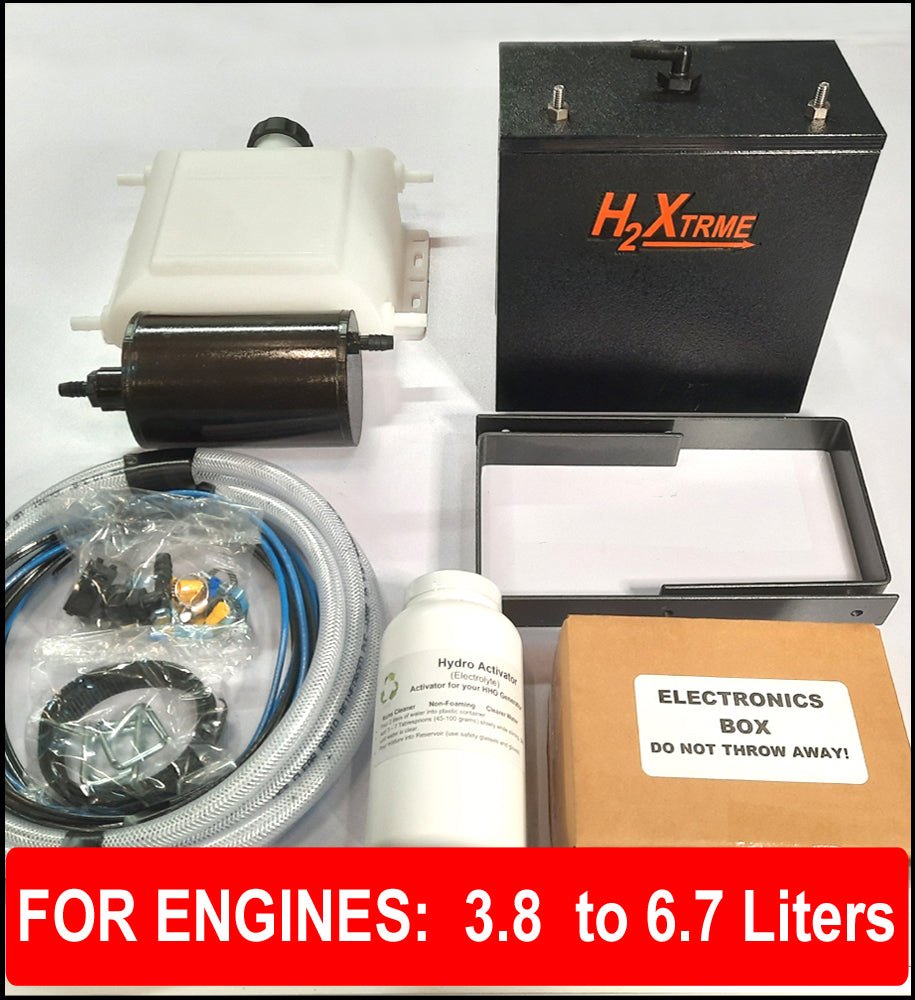
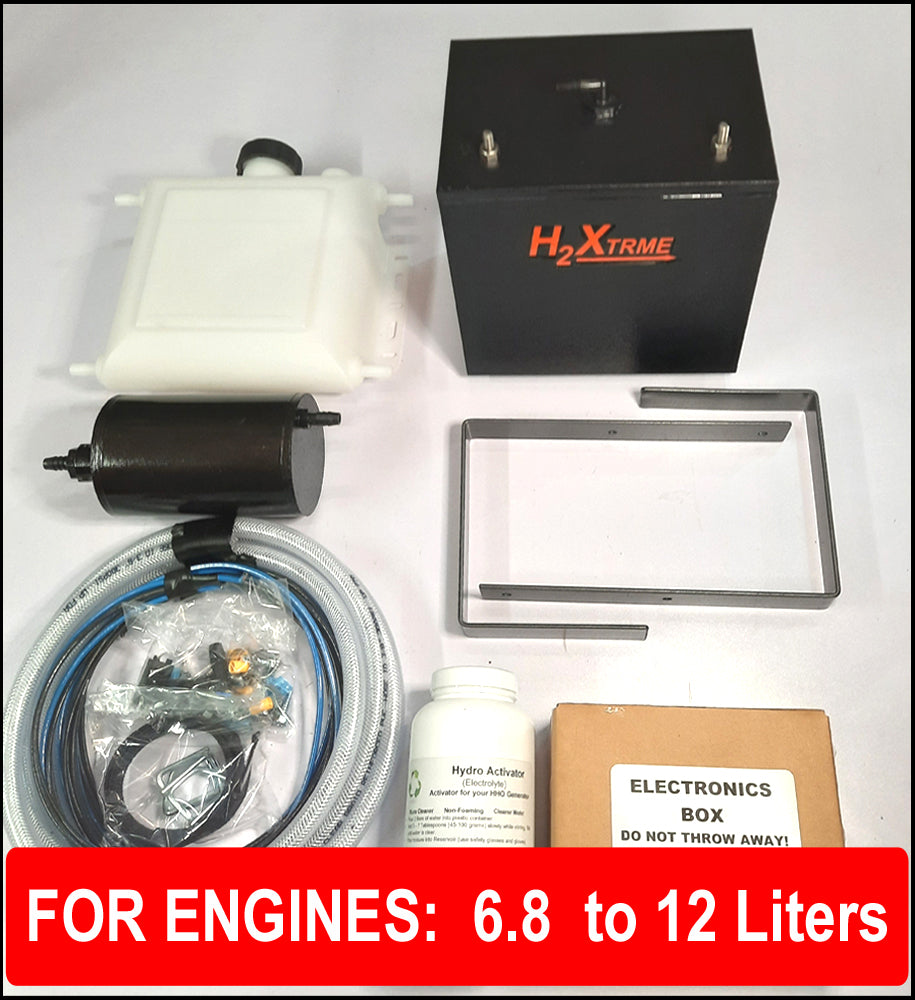
Start with the displacement on your engine badge or registration, not a guess. A 3.7-liter V6 sits at the top of the small kit; a 3.8-liter V6 belongs to the medium kit. Getting this wrong is the most common fitment error we see.
Next, confirm your fuel system. Carbureted engines run without a tuner. Fuel-injected gasoline vehicles from 1987 onward generally need a gas tuner, and diesels with electronic control need a diesel tuner. Then check underhood space: measure the mounting area against the generator's footprint before ordering.
Finally, plan your baseline. Record fuel economy for a few tanks, install, then record again under similar driving. That record is what separates a real result from a hopeful one.
The real challenge with any hydrogen kit is separating a genuine result from a hopeful one, and that starts with honest specifications and a kit sized to your engine. HHOKitsDirect builds the H2XTRME line around exactly that: chemically welded, permanently sealed generator containers that eliminate gaskets, internal plate retainers that cut leak points, and simplified installation with just two electrical terminals and two hose connections.
Independent verification of manufacturer MPG claims is thin. Before buying any hydrogen injection kit, ask for baseline MPG data from a vehicle like yours, confirm the return policy, and track your own before-and-after fuel consumption over several tanks so the result is measured rather than assumed.
Pricing for the Fuel Genie hydrogen injection kit is not published in the research used for this review, so confirm the current figure directly with the seller before ordering. For context, H2XTRME HHO kits from HHOKitsDirect run $597.00 for 1.1 to 3.7 liter engines, $747.00 for 3.8 to 6.7 liters, and $897.00 for 6.8 to 12 liters. Add tax and shipping when calculating your payback period.
Risks come from poor installation, wiring faults, or water entering the intake. Follow the safety precautions in the manual, mount the generator and bubbler securely, and use the control relay as specified.
Confirm engine displacement against the kit's stated range, and choose the right tuner option: no tuner for carbureted vehicles, gas tuner for fuel-injected gasoline cars from 1987 on, diesel tuner for electronic diesel engines. Check the refund policy and warranty terms, ask whether the kit ships with a full installation guide, and note your baseline MPG before installation so you can measure any change in fuel economy honestly.

Subscribe to our newsletter and always be the first to hear about what is happening.
© 2026 HHOKitsDirect.com
Designed by Out of the Sandbox. Powered by Shopify


Note and Disclaimer: Hydrogen or Hydroxy gas and hydrogen cells are experimental technologies, results vary depending on application success is not guaranteed.

Editorial Team
Author