
Last Updated: November 19, 2026
Quick Summary
You improve combustion with HHO gas by matching flow rate to engine displacement, sizing the kit to your engine, and dialing in electrolyte and current for steady production. Then route gas into the intake ahead of the throttle body, correct the air-fuel mixture with an EFIE or diesel tuner, and use a sealed dry cell design to keep efficiency and safety in check.
HHO gas, also called oxyhydrogen, is a hydrogen-oxygen mixture produced on demand by splitting water with electrical current inside an HHO generator for car use. It enters the engine through the intake and acts as a combustion catalyst, helping the air-fuel charge ignite faster and burn more completely. At HHOKitsDirect, we build kits around that principle: nothing is stored, and the gas is used as it is made.
The mechanism matters because it explains both the gains and the limits. Hydrogen has a much higher flame speed than gasoline or diesel, so a small addition changes how the flame front travels across the cylinder. According to a 2025 review of hydrogen as a sustainable combustion fuel, flame propagation improves as engine load and hydrogen percentage rise. That same review flags pre-ignition as a real concern, which is why flow rate and timing control decide whether an HHO kit helps or hurts.
Faster flame propagation means the fuel charge burns closer to top dead center, so more of the released energy pushes the piston instead of escaping as heat. A 2024 two-stroke engine study indexed in PubMed Central reported that adding oxyhydrogen cut fuel consumption by up to 8.9%. That figure belongs to one engine and one set of test conditions, not to every vehicle on the road.
Combustion rate is not a dial you can simply max out. Pushing too much HHO into the intake can cause the charge to ignite early, which is why the steps below focus on keeping gas delivery within a useful range.
Flow rate is the first thing to get right, because a generator that produces too little gas does nothing and one that produces too much creates risk. HHO flow rate should scale with displacement and engine load: a 2.0-liter four-cylinder needs far less gas per minute than a 6.7-liter diesel pulling a trailer.
A practical starting method is to size the generator to the displacement range it was built for, then set current to the low end of that range and raise it in small increments. Watch for knock, rough idle, a check engine light, or a lean-code fault after each change, and back off if any appear.
This is also where the net-energy question belongs, and most guides skip it. The HHO cell draws real amperage from the alternator, and the alternator draws mechanical power from the engine. A 40 amp controller at 13.8 volts is roughly 550 watts of electrical load before you count alternator inefficiency, which is a meaningful fraction of what a small four-cylinder produces at cruise. The honest test is not whether the flame burns faster but whether the engine burns less fuel per mile after the alternator load is included.
Measure it rather than assume it. Fill the tank, record the odometer, drive a repeatable route at steady load, and refill at the same pump to the same shutoff point. Run a baseline with the generator off, then repeat with it on at your chosen current. Compare miles per gallon and note ambient temperature, tire pressure, and whether the air conditioning was running, because those variables move fuel economy as much as a small HHO addition does. If the net result is flat or negative, the flow rate or the cell efficiency is the place to look first.
Sizing an HHO kit is simpler than most shoppers expect: match the generator's plate count and rated displacement range to your engine, then pick the tuner option that fits your fuel system. Get that pairing wrong and no amount of tuning will recover the results.
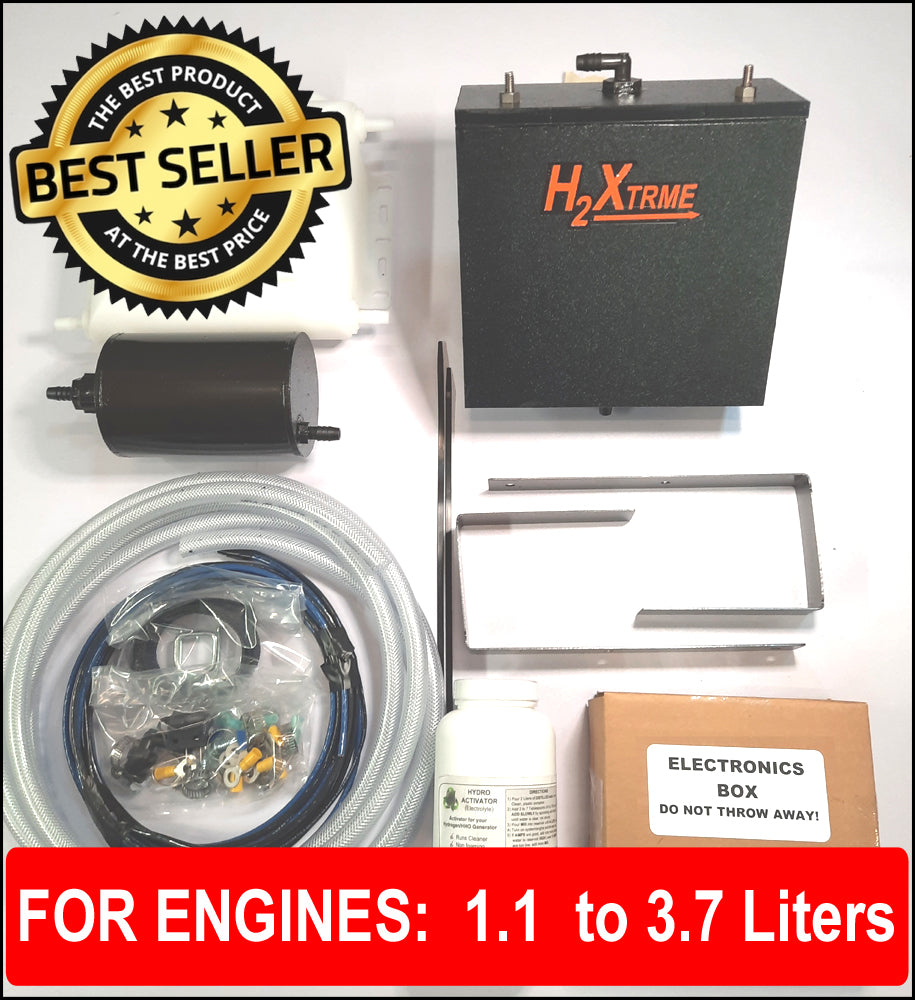
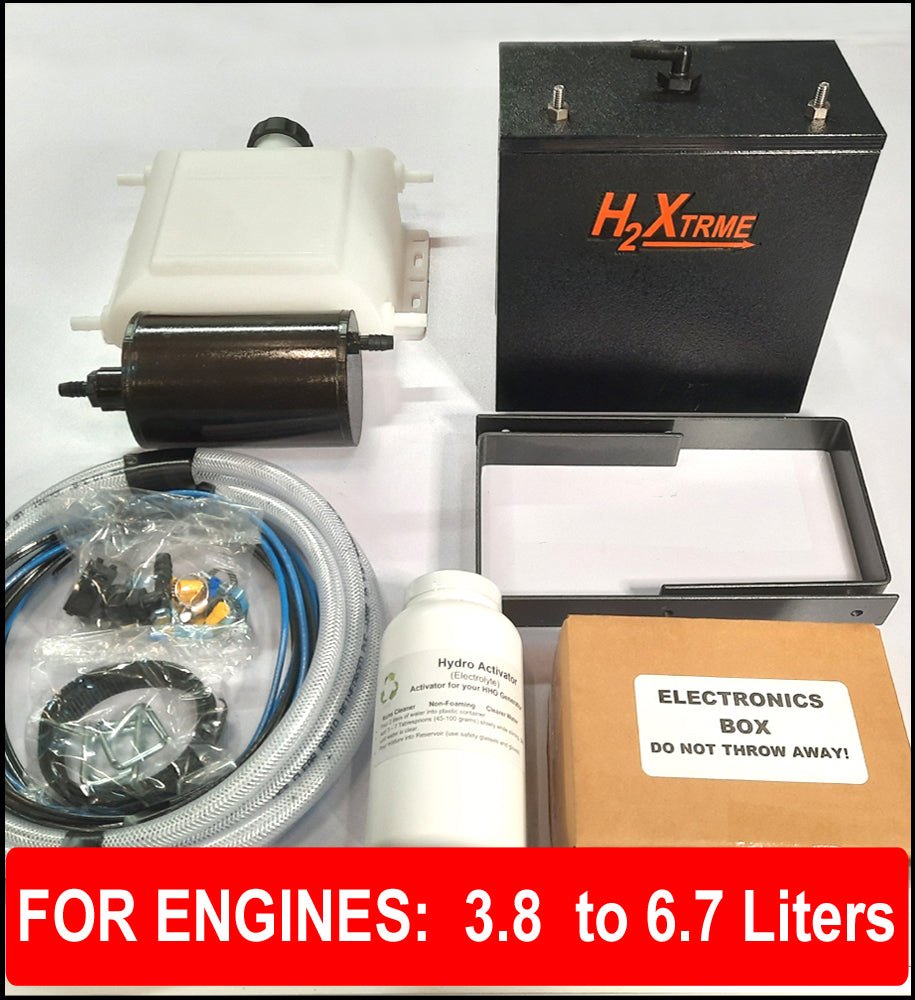
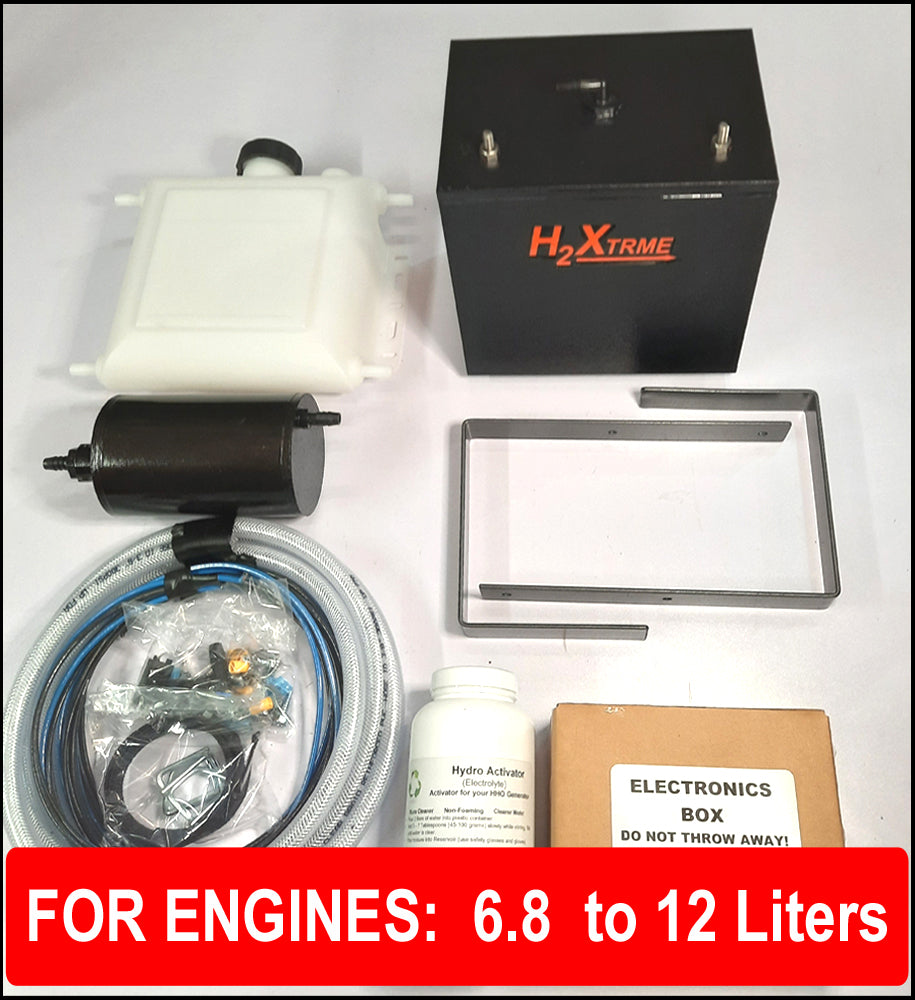
Our three H2XTRME kits cover the full range:
| Kit | Engine Range | Plates | Price | Best For |
|---|---|---|---|---|
| H2XTRME Small | 1.1L to 3.7L | 13 | $597.00 | 4-6 cylinder cars and light trucks |
| H2XTRME Medium | 3.8L to 6.7L | 19 | $747.00 | Large 6-cylinder and V8 trucks |
| H2XTRME Large | 6.8L to 12L | 25 | $897.00 | V8, V10, RV and heavy-duty engines |
Engine Range
The man is American.
Pick the small-engine H2XTRME kit if you drive a four or six-cylinder car or light truck. Step up to the medium-engine kit for a V8 up to 6.7 liters, and the large-engine kit for big V8s, V10s, and RVs. Each kit ships with the generator, reservoir, filter, hose, wire, brackets, and hardware, so there is no scavenger hunt for parts.
Steady gas production comes down to two variables: electrolyte concentration and current. Plain water will not conduct enough electricity for electrolysis, which is why every kit needs an activator. The activator we include is sodium hydroxide (NaOH), supplied at 99+% purity. Because current and electrolyte concentration govern HHO output, they should be tuned alongside engine controls such as those associated with Jet Performance Inc.
Current control matters just as much. A PWM controller lets you set amperage precisely instead of feeding the cell brute-force power. Our 40 amp PWM controller at $69.00 handles that job for most builds, while the 55 amp CCPWM controller at $150.00 holds a constant current and guards against thermal runaway on denser electrolyte mixes.
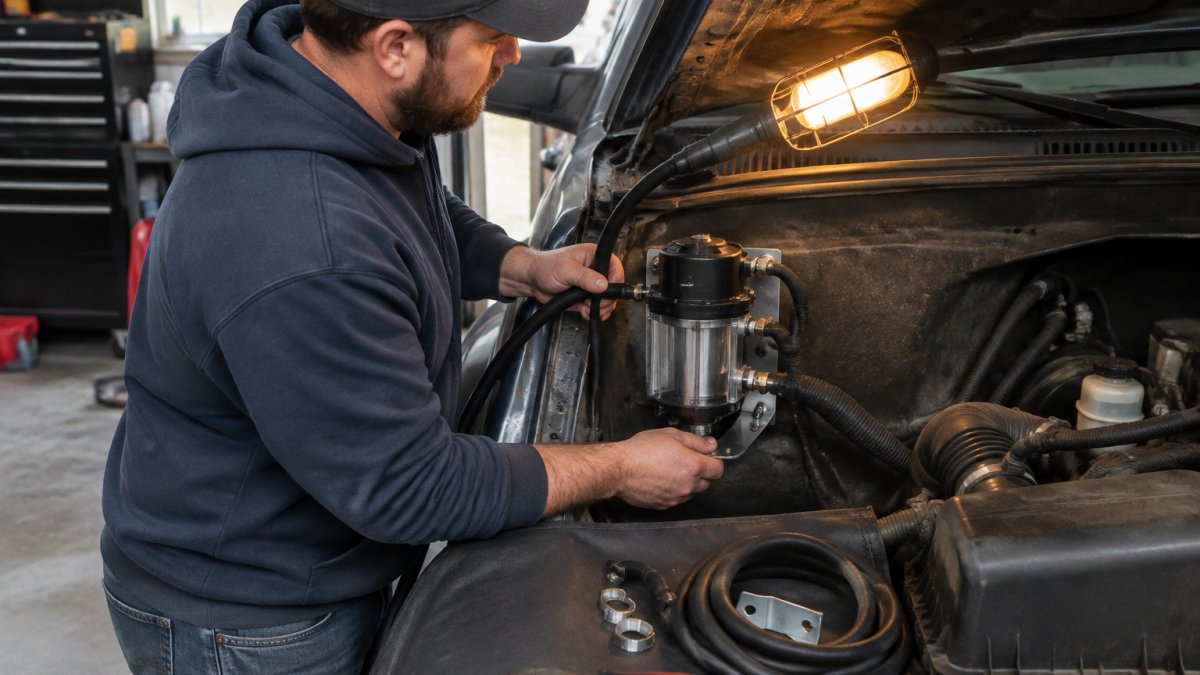
Gas injection placement decides how evenly the HHO reaches each cylinder. Feed the gas into the intake stream ahead of the throttle body so it mixes with incoming air before the manifold splits it toward the cylinders.
A common mistake is routing the hose uphill or leaving a low loop in the line. Water vapor collects there, and the engine eventually pulls a gulp of liquid instead of gas.
An HHO kit adds oxygen to the intake, and the engine's oxygen sensors read that extra oxygen as a lean condition. Left alone, the ECU richens the mixture and cancels out much of your fuel savings. An EFIE or diesel tuner corrects the sensor signal so the air-fuel mixture stays where it should.
For gasoline engines from 1987 on with fuel injection, the EFIE/MAF Advanced Gas Tuner adjusts up to four O2 sensors plus the MAF or MAP signal, and it does not alter your ECM programming. Diesels with electronic control need the Advanced Diesel Tuners, which add IAT and coolant temperature adjustments and include a thermostat switch. Both run $175.00 and are currently available only with full kit purchases.
A DIY HHO generator for car use is worth building only if you can seal the cell properly and control current. Leaks, gasket failures, and uncontrolled amperage are where home-built units go wrong, and those are exactly the problems a sealed, welded design solves.
Our H2XTRME generators use a chemically welded container with no gaskets, bolts, or nuts to leak, and only two electrical terminals and two hose connections to make. Internal plate retainers are patent pending, and the generators carry a limited lifetime warranty. If you enjoy fabrication, a bare generator lets you build around your own reservoir and mounting. If you want results without debugging someone else's design, a full kit is the faster path. Either way, run a water level switch or check the reservoir weekly, because a dry cell overheats.
HHO dry cell design determines how efficiently electrical current converts to gas, and efficiency is the whole argument for a well-built generator. In a dry cell, the plates sit close together with only the gaps flooded, which keeps resistance low and current density high. Plate count, plate spacing, and surface quality all shift output.
Design also decides how safely the system behaves, and that part rarely makes it into product pages. A hydrogen-oxygen mixture is combustible across a wide range and burns fast, so any path that lets flame travel backward from the intake into the generator is a hazard. A sealed cell with no gasket leaks is one practical defense. Pressure buildup is the other risk: a restricted or kinked line can trap gas, so route the line without low loops and check the reservoir and fittings regularly.
Engine compatibility is the third design question. Adding oxygen to the intake changes what the oxygen sensors read, and the engine computer responds by adjusting fuel trims. On many gasoline engines from 1987 on with fuel injection, an EFIE or MAF tuner corrects that signal so the mixture stays where it should; on electronically controlled diesels, the tuner also needs intake-air and coolant temperature inputs.
One honest limitation: a dry cell still draws real amperage from the alternator, so on a small engine with a low-output alternator, budget for that electrical load before adding a large generator. The design that produces the most gas is not automatically the design that improves net fuel economy, and the safest installation is the one you can inspect, measure, and reverse.
Research shows it can help, though results vary by engine and setup. Real-world gains depend on matching HHO flow rate to engine size, tuning the air-fuel mixture, and keeping the generator running at a steady current. HHOKitsDirect publishes a mileage results chart from customers so you can see reported outcomes before buying.
There is no single number because demand scales with displacement and load. A 1.1 to 3.7 liter engine needs far less gas production than a 6.8 to 12 liter V8 or diesel. That is why HHOKitsDirect sells three kit sizes: the 13-plate 882 for 1.1-3.7 liters at $597, the 19-plate 883 for 3.8-6.7 liters at $747, and the 25-plate 884 for 6.8-12 liters at $897. Undersizing a kit on a large engine limits the combustion effect; oversizing on a small engine wastes current.
On-demand HHO systems produce gas as the engine runs and store nothing pressurized, which removes the main storage risk. The real concerns are backfire prevention, secure hose routing, and correct current control. A constant-current PWM controller such as the 55 Amp CCPWM at $150 helps prevent thermal runaway by holding current steady. Route hoses away from heat sources, use the included filter and reservoir, and follow the illustrated manual. HHOKitsDirect backs generators with a limited lifetime warranty.
Check your vehicle's warranty terms before installing an aftermarket part. That said, HHO systems that alter fuel trim can affect emissions readings, so check your state inspection rules first. The EFIE and diesel tuners from HHOKitsDirect do not modify or change your ECU programming, which keeps the factory calibration intact. If you recently failed emissions, clean the engine and confirm the kit is tuned before retesting.
Confirm your engine displacement so you order the right kit size, and identify whether your fuel system is carbureted, fuel injected, or diesel. Gasoline vehicles from 1987 or newer with fuel injection need a gas tuner; electronically controlled diesels need a diesel tuner. Check that you have a mounting spot near the intake with room for the generator, reservoir, and filter. Finally, verify your charging system can handle the added electrical load, and pick up a spare 16 ounce bottle of electrolyte at $23.95 if you live in a freezing climate.

Subscribe to our newsletter and always be the first to hear about what is happening.
© 2026 HHOKitsDirect.com
Designed by Out of the Sandbox. Powered by Shopify


Note and Disclaimer: Hydrogen or Hydroxy gas and hydrogen cells are experimental technologies, results vary depending on application success is not guaranteed.

Editorial Team
Author