Last Updated: November 4, 2026
Quick Summary
The essential hho kit components are the generator (cell stack), reservoir, filter, hoses and wiring, mounting brackets, and a tuner or controller. Each part has a specific job, from producing hydrogen and oxygen gas to regulating the current the generator draws.
An HHO kit splits water into hydrogen and oxygen gas using an electric current, and the gas is fed into your engine's intake to support combustion, so every one of the hho kit components has to work together for the system to run reliably. The process is called electrolysis, and in a vehicle it runs on demand: the generator only produces gas while the engine is running and drawing power from the alternator. Because the gas is made as needed rather than stored, the system stays simple and the fuel never needs to be carried in a tank.
The reaction needs three things: distilled water, an activator to carry current, and electrical energy. Plain water conducts electricity poorly, which is why every kit includes an electrolyte. HHOKitsDirect includes a 16-ounce bottle of sodium hydroxide activator with every H2XTRME kit. Watch out: the gas is flammable, so the generator must be wired and plumbed exactly as the manual describes.
A complete kit contains a few parts that work together. Knowing what each of the hho kit components does makes troubleshooting far easier later on.
Match the generator size to your engine. Each H2XTRME kit covers a specific displacement range: 1.1 to 3.7 liters for small engines, 3.8 to 6.7 liters for medium, and 6.8 to 12 liters for large.
Electrode plates are where much of the design work in a generator happens. Plate count, spacing, and material all affect how a cell performs.
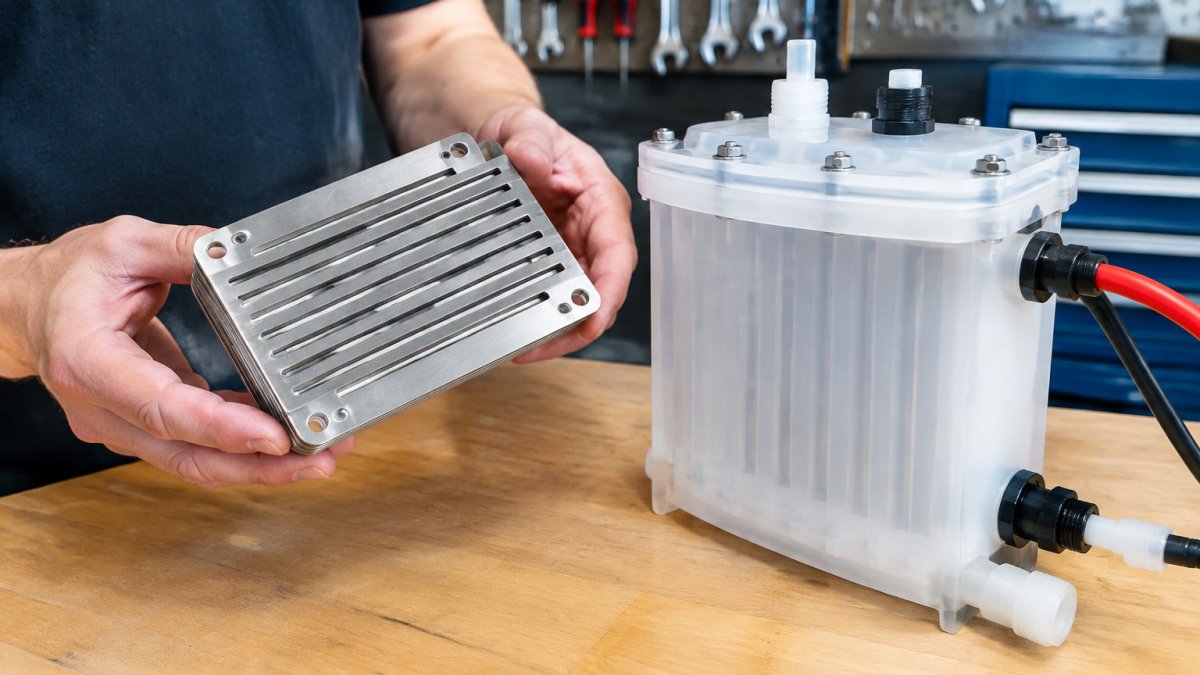
The H2XTRME generators use a sealed, welded plastic container rather than gaskets and bolts, which removes those seals as potential leak points.
Pulse width modulation (PWM) controls the average current sent to the generator by switching the power on and off rapidly. This matters because too much current overheats the cell and wastes energy without adding gas.
When installing a PWM controller, connect the input leads to a switched 12-volt source so the generator only runs with the engine. Fuse the positive line close to the battery, route wiring away from moving parts, and confirm the controller's current setting before the first start. The installation steps are covered in more detail in our DIY HHO Kit Installation Guide: Step-by-Step Setup.
The electrolyte determines how easily current flows through the water and how clean the reaction runs. HHOKitsDirect prefers sodium hydroxide (NaOH) after 16 years of building and testing kits. It produces less foaming than many alternatives and costs less per gram at the 99%-plus purity grade they buy.
Use the activator at the concentration in the manual. Adding more does not produce proportionally more gas, and it accelerates electrode wear. In freezing climates, the activator solution can freeze near -30 degrees F, so buy an extra 16-ounce bottle and make sure a PWM controller is in place to prevent freezing damage.
The harder question is what happens to output at month six, month twelve, and beyond, because electrode scaling and electrolyte depletion are the two forces that quietly erode gas production over the life of any cell. A maintenance plan built around those two mechanisms keeps output close to the day-one baseline instead of letting it drift downward unnoticed.
What actually degrades. During electrolysis, minerals and reaction byproducts deposit on the plate surfaces as scale. Scale is an electrical insulator, so as it builds, the cell needs more voltage to push the same current, and the extra energy turns into heat rather than gas.
A 12-month maintenance cadence.
Electrode degradation over the long term. Stainless steel and titanium resist corrosion, but they are not immune. Repeated thermal cycling, scale buildup, and electrolyte concentration above the manual's recommendation all accelerate plate wear. Running a higher activator concentration does not produce proportionally more gas, it shortens electrode life and increases foaming.
NEW! H2XTRME HHO KIT - for SMALL size engines from 1.1 liters to 3.7 liters →
Freezing climates. The activator solution can freeze near -30 degrees F. In cold regions, keep the PWM controller in place so the cell runs only when the engine is warm, and store a spare 16-ounce bottle of activator so a freeze event does not leave you waiting on a shipment. Never top off a frozen reservoir with hot water, thermal shock can crack plates.
Watch out: if output drops sharply after a top-off, suspect over-concentration of activator rather than a failed generator, and dilute back to the manual's mix before replacing parts.
Our guide on How to Maintain HHO Generator Systems: A 2026 Guide walks through a full schedule. If you drive an older car, read How to Add a Hydrogen Generator to a High-Mileage Vehicle before installing, since older engines often have more carbon buildup and different intake conditions.
Safety hardware and output diagnostics belong together because the same components that protect the system are the ones most likely to cause a low-output complaint when they degrade. A non-return valve prevents liquid and pressure from flowing backward into the generator, and a flashback arrestor stops a flame from traveling up the gas line into the cell.
Diagnose low output in a logical order. Work from the cheapest and most likely cause to the most expensive, and change one variable at a time so you know what fixed it.
Measure before you replace. A clamp meter on the positive lead tells you actual current draw, and comparing it to the manual's specification separates an electrical problem from a cell problem in minutes.
Legal and insurance reality. Modifying a vehicle's fuel system can affect warranty coverage and, in some cases, insurance. Before installing, check your policy's terms on aftermarket modifications and confirm with your state's inspection program whether the addition affects emissions compliance. Keep the manufacturer's documentation and installation records, they matter if a claim ever arises. HHOKitsDirect's H2XTRME generators carry a limited lifetime warranty.
Watch out: never test for gas leaks with a flame, and never operate the generator with the flashback arrestor removed, hydrogen flashback into the intake manifold is the failure mode the safety parts exist to prevent.
The article lays out a logical order for diagnosing low hydrogen output, from the most likely cause to the least.
| Step | Check | Fix |
|---|---|---|
| 1 | Water level and electrolyte concentration | Top off with distilled water; reset activator to manual mix |
| 2 | Filter restriction | Replace if discolored |
| 3 | Electrical connections | Clean corrosion; tighten terminals and ground |
| 4 | Fuse and PWM settings | Confirm current limit against the manual |
| 5 | Cell condition | Inspect for scale or plate discoloration |
Your engine size decides which generator fits. The NEW! H2XTRME HHO KIT for SMALL size engines from 1.1 liters to 3.7 liters at $597.00 suits small cars and trucks with four- to six-cylinder engines. The NEW! H2XTRME HHO KIT for MEDIUM size engines from 3.8 liters to 6.7 liters at $747.00 covers larger six- and eight-cylinder engines up to 6.7 liters. For engines from 6.8 to 12 liters, the NEW! H2XTRME HHO KIT for LARGE engines at $897.00 is the match. If you already have a generator and only need a replacement, the activator is sold separately at $23.95.
Choose your tuner next: most gas vehicles from 1987 onward use the gas tuner, diesels need the diesel tuner, and advanced gas users can choose the Pro Series tuner. Pick the kit that matches your engine, add the activator, and follow the illustrated manual to get started.
HHO kits can improve combustion in some engines, but results vary by vehicle, engine size, driving habits and how well the system is installed and tuned. HHOKitsDirect offers H2XTRME kits sized for engines from 1.1 liters to 12 liters, with a Limited Lifetime warranty on H2XTRME generators. Independent, repeatable fuel economy data is limited, so check the mileage results chart and set realistic expectations before buying. Keep your receipts and record your baseline MPG so you can measure your own results.
A pulse width modulation (PWM) controller regulates the electrical current sent to the generator, which controls how much hydrogen and oxygen the cell produces. Limiting current helps keep output stable and reduces heat and wasted energy. Some electrolyte kits include a PWM controller and some do not, so confirm your package contents before installation, and add a controller if your kit lacks one.
Plain water conducts electricity poorly, so an electrolyte is needed for electrolysis to produce gas efficiently. HHOKitsDirect includes a 16-ounce (454 grams) bottle of sodium hydroxide (NaOH) with every H2XTRME kit, . Too little electrolyte reduces output, while the wrong concentration can cause foaming. Users in freezing climates should add a second bottle and a PWM controller to prevent the solution from freezing at temperatures down to -30 degrees F.
Common signs include weak or inconsistent gas output, excessive heat or foaming in the reservoir, and a generator that draws high current without producing much gas. Check that electrode plates are clean, the electrolyte level and concentration are correct, and the electrical connections are secure. Confirm that the current stays within the recommended limit, and inspect the hoses and filter for restrictions. Persistent issues after these checks may indicate a fault that needs professional diagnosis.

Subscribe to our newsletter and always be the first to hear about what is happening.
© 2026 HHOKitsDirect.com
Designed by Out of the Sandbox. Powered by Shopify


Note and Disclaimer: Hydrogen or Hydroxy gas and hydrogen cells are experimental technologies, results vary depending on application success is not guaranteed.

Editorial Team
Author